The Agent Loop
Tools & ExecutionOne Loop Is All You Need
The smallest useful agent is a loop that calls the model, runs tools, and feeds results back.
s01 → s02 → s03 → s04 → ... → s20
"One loop & a shell is all you need" — one tool + one loop = an agent.
Harness layer: the loop — the first connection between the model and the real world.
The Problem
You ask the model: "List the files in my current directory, then run XXX.ts."
The model can emit a shell command, but then it stops — it won't run it, can't see the result, and can't keep reasoning from that result.
You could run it yourself, paste the output back, and let it continue; when the next command appears, you run and paste again.
Every round trip, you are the middleman. Automating that middleman is what this chapter is about.
The Solution
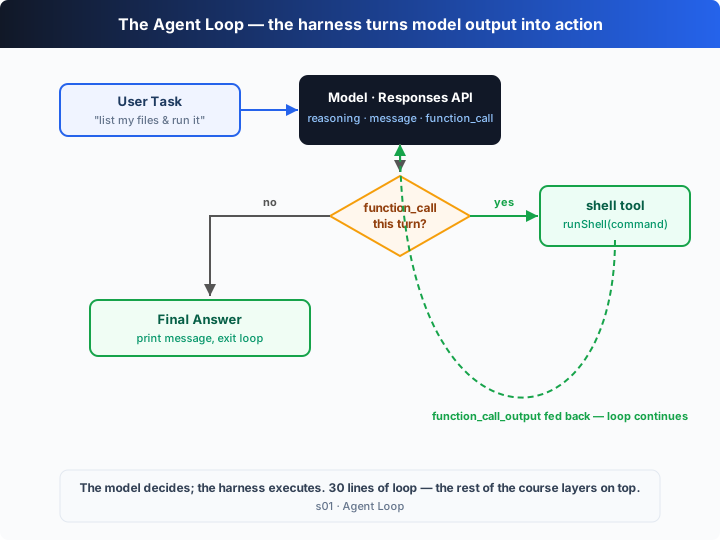
A for (;;) loop: keep going while the model calls tools, stop when it doesn't. Codex uses the OpenAI Responses API — each turn the model returns a list of output items, and the loop only cares about one signal:
| output item | meaning | loop action |
|---|---|---|
type == "function_call" | the model says "I want to use a tool" | execute → feed the result back as a function_call_output → continue |
no function_call (only a message) | the model says "I'm done" | print the final text, exit the loop |
A reasoning item is the chain-of-thought of a reasoning model like the ones Codex runs on; the harness keeps it in context and it doesn't change the loop.
How It Works
Translate this into TypeScript, step by step:
Step 1: the user's question becomes the first input item.
const thread = [{ role: "user", content: query }];
Step 2: send the input plus tool definitions to the model (Responses API).
const resp = await openai.responses.create({
  model: MODEL, instructions: INSTRUCTIONS,
  input: thread, tools: TOOLS,
  reasoning: { effort: "medium" },   // Codex runs on reasoning models
});
Step 3: append the whole turn (reasoning + message + tool calls) to the thread, then check for tool calls. None → done.
thread.push(...resp.output);
const calls = resp.output.filter((i) => i.type === "function_call");
if (calls.length === 0) return;
Step 4: execute each tool call and collect the results.
for (const call of calls) {
  const { command } = JSON.parse(call.arguments);
  const result = runShell(command);
  thread.push({ type: "function_call_output", call_id: call.call_id, output: result });
}
Step 5: results are back in the thread — go to step 2.
Assembled into one function:
async function agentLoop(input) {
  for (;;) {
    const output = await callModel(input);
    input.push(...output);

    const calls = output.filter((i) => i.type === "function_call");
    if (calls.length === 0) return;            // no more tool calls → done

    for (const call of calls) {
      const result = runShell(JSON.parse(call.arguments).command);
      input.push({ type: "function_call_output", call_id: call.call_id, output: result });
    }
  }
}
Thirty-odd lines: the smallest runnable kernel of an agent harness. It isn't intelligence itself — it's the minimal frame that lets the model keep acting. The model decides (whether to call a tool, and which); the harness executes (run it, feed the result back). The next 19 chapters layer mechanisms on top of this loop, and the loop itself never changes.
Try It
Teaching demo note: the code runs shell commands the model generates. Run it in a scratch directory so you don't touch real project files. s03/s04 build the real approval + sandbox system.
No API key needed: without OPENAI_API_KEY, this chapter drives the full loop with a built-in offline scripted model (it pretends to call shell twice, then wraps up), so you can understand the mechanism first.
Setup (first run):
npm install
cp .env.example .env        # fill in OPENAI_API_KEY and MODEL_ID to run the real model
Run:
npx tsx s01_agent_loop/code.ts                # offline demo model
OPENAI_API_KEY=sk-... npx tsx s01_agent_loop/code.ts   # real model
Try these prompts:
Create a file called hello.ts that prints "Hello, Codex!"List all TypeScript files in this directoryWhat is the current git branch?
Watch for: when does the model call a tool (loop continues), and when does it stop (loop ends)?
What's Next
Right now the model only has the shell tool: reading a file means cat, writing means echo ... >, finding means find — ugly and error-prone.
s02 Tool Use → give it a set of real structured tools (read, write, apply_patch, search). What happens? Will it call several tools in parallel? Do concurrent tools step on each other?
Into the Codex source
The following is based on the overall structure of OpenAI's open-source
openai/codexrepo (codex-rs, written in Rust). The chapter's thirty-linefor (;;)is the minimal skeleton of Codex's core turn loop; every difference is a protection mechanism added for production robustness.
The chapter's agentLoop ≈ Codex's turn loop. Each item below hardens that core.
1. Loop condition: more than "no function_call means stop"
The chapter decides whether to continue by "did this turn still contain a function_call". Codex's core loop (run_turn / try_run_turn in core) consumes a stream of events: the harness sees each ResponseItem as the model generates it and dispatches a tool call as soon as it's complete, rather than waiting for the whole turn. That lets tools start earlier and run in parallel (see s13 on background tasks).
2. Session state: the chapter only has one input array
| # | Concept in Codex | purpose | chapter |
|---|---|---|---|
| 1 | conversation history / turn context | the input items for this iteration | s01 |
| 2 | ExecPolicy + sandbox handle | how each command is approved and where it runs | s03 / s04 |
| 3 | compaction state | auto-compact when context fills up | s08 |
| 4 | session rollout / persistence | resume, codex resume | s09 |
| 5 | error & retry counters | classify and recover from failures | s11 |
The chapter keeps only #1; the rest are added back one per chapter.
3. Multiple exit & recovery paths
The chapter has one exit (the model stops calling tools). A production Codex turn also handles: user interrupt (Esc), approval denial, sandbox violations, model rate limits and retries, output-token ceilings, and compaction retries when context overflows. Each maps to a recovery or exit strategy (expanded in s11, error recovery).
4. Approval & sandboxing are the real differentiators
Codex makes "can this command run, and where" a first-class citizen of the harness: approval_policy (untrusted / on-failure / on-request / never) decides when to stop and ask a human, and sandbox_mode (read-only / workspace-write / danger-full-access) plus OS-level isolation (Seatbelt on macOS, Landlock on Linux) decides what a command can actually touch. This chapter only uses a string match as a stopgap; s03/s04 build the real thing.
In one line: Codex's production turn loop is still "call the model → run the tool → feed the result back" at its core. Every extra field and exit path is a protective mechanism. Master the core loop first and everything else unfolds naturally.