Sessions, Sandbox & Safety in Depth
Codex in DepthFork, Trust, and the Full Safety Model
The full session lifecycle (resume/fork/archive) and the safety knobs that dial autonomy from read-only up to full bypass — gated by feature flags.
s01 → ... → s23 → ... → s27 → s28
"One dial from 'ask me everything' to 'just run it'" — safety is not a single switch but a "may this run?" decision stacked out of four gates.
Harness layer: Codex deep-dive — what changes is not the loop, but "how many gates an action must clear before it may run."
The Problem
In Part I we took the loop apart; across Part II we've come a long way: s21 covered the command surface, s22 parsed every knob in config.toml, and s23 showed the loop running unattended in review, CI, and the cloud. But two questions have been hanging:
-
Where do sessions go when they end? The session you left half-finished at midnight, the experiment you abandoned last week — they didn't vanish; they're all rollouts persisted to disk. The question is: how do you pick one back up (
resume)? How do you branch off a good state to try something risky without wrecking the original (fork)? How do you put the seldom-used ones away without deleting them (archive)? When do you actually delete (delete)? Without a clear lifecycle model, dozens of sessions quickly become a tangled mess. -
Is "letting it run" one act, or a chain of decisions? On one end is total caution — approving every command by hand; on the other is
--dangerously-bypass-approvals-and-sandbox— ask nothing, and skip the sandbox too. In between lies a wide spectrum: a read-only sandbox, a writable workspace,--add-dirfor extra room, whether to enable experimental features, whether this project is trusted, whether to add a guardian re-review. Real Codex collapses this continuum into "one action + one set of config → one allow / ask / deny" verdict. The question is: in what order do these gates — feature flag, bypass, sandbox, approval/trust — stack, and how do they combine into a single decision?
These two questions are really one: autonomy is not on-or-off, it's a dial. The session lifecycle governs "which conversation lives on"; the safety resolver governs "may this action run." This chapter teaches both.
The Solution
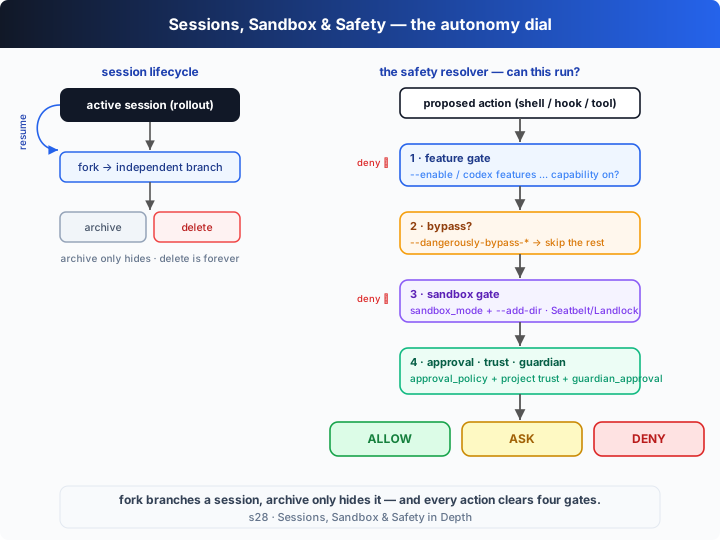
First: the session lifecycle. Every run is a persisted rollout (the .jsonl of s09), and the CLI gives it a set of management commands. The key distinctions: fork branches (the source session is untouched, the copy evolves independently), archive only hides (the rollout stays on disk, still visible via --all), and only delete is permanent.
| Command | What it does | Key point |
|---|---|---|
codex resume [--last|<SESSION>] [PROMPT] | Reload a session and continue | Picker by default; --last continues the most recent; --all disables cwd filtering |
codex fork [--last|<SESSION>] [PROMPT] | Branch a session | Copies a new session with full history, parentId pointing at the source; the source is unaffected |
codex archive <SESSION> | Archive (hide) | Just sets a flag, hides it from the default picker; does not delete data |
codex unarchive <SESSION> | Unarchive | Makes it visible again |
codex delete <SESSION> | Permanently delete | The only irreversible operation |
The <SESSION> arg | UUID or session name | UUID takes precedence: if it parses as a UUID it matches by id, else by name |
Second: the safety resolver. Before it executes, every action (shell command / hook / tool call) clears four gates in a fixed order; any gate can deny outright, and only after all pass does "must a human say yes?" come into play:
| Gate | Controlled by | Real switch | If not satisfied |
|---|---|---|---|
| 0 · hook trust | Project trust / persisted hook trust | [projects."<path>"] · --dangerously-bypass-hook-trust | deny (a hook is code from config; it needs trust first) |
| 1 · feature gate | Whether the feature is in effect | --enable/--disable <FEATURE> · codex features enable|disable | deny (the capability is off) |
| 2 · total bypass | One flag to skip sandbox+approval | --dangerously-bypass-approvals-and-sandbox | If set, allow directly (extremely dangerous) |
| 3 · sandbox gate | Physical FS/network boundary | -s, --sandbox <MODE> · --add-dir <DIR> | deny (out of bounds; physically refused) |
| 4 · approval/trust/guardian | Must a human say yes | -a, --ask-for-approval <POLICY> · project trust · guardian_approval | ask (escalate) or allow |
The three sandbox_modes (-s, --sandbox) (the real backend is Seatbelt on macOS / Landlock on Linux, see s04):
| Mode | Writes | Network | In one line |
|---|---|---|---|
read-only | all refused | refused | look but don't touch |
workspace-write | allowed inside the workspace + --add-dir roots | off by default | the default working mode |
danger-full-access | unbounded | unbounded | no sandbox boundary |
approval_policy (-a, --ask-for-approval): the CLI's -a accepts untrusted / on-request / never; the approval_policy in config.toml adds on-failure.
| Policy | Meaning |
|---|---|
untrusted | Only "trusted" read-only commands (ls/cat/sed…) run without asking; anything the model proposes beyond that escalates to the user |
on-request | The model decides when to ask for approval |
on-failure | Run first, ask only on failure (config file only) |
never | Never ask; execution failures are returned to the model immediately |
The two dangerously bypasses (why they're dangerous): they are not "more convenient" — they tear down guardrails the harness built for you, and should only be used where "the external environment is already sandboxed" (an ephemeral container, a CI runner).
| Flag | What it skips | Real warning text |
|---|---|---|
--dangerously-bypass-approvals-and-sandbox | all confirmation prompts + the sandbox | "Skip all confirmation prompts and execute commands without sandboxing. EXTREMELY DANGEROUS. Intended solely for running in environments that are externally sandboxed." |
--dangerously-bypass-hook-trust | the persisted-trust requirement for hooks | "Run enabled hooks without requiring persisted hook trust for this invocation. DANGEROUS." |
guardian_approval (an extra approval layer): this is a stable feature (guardian_approval = stable, true in codex features list). It adds a second reviewer on top of the approval policy — even if approval_policy=never would have allowed it, a risky action is still forced back to ask.
Feature flags are the master switch for experimental capabilities: codex features list shows each feature's "stage + effective state"; codex features enable/disable <FEATURE> writes it into config.toml (equivalent to -c features.<name>=true/false, and to the CLI's --enable/--disable <FEATURE>). Verified on v0.144.6: browser_use, computer_use, image_generation, goals, hooks, guardian_approval, fast_mode, apps, code_mode_host are all stable; memories is experimental (off by default), as are network_proxy and prevent_idle_sleep; and a batch is under development. The earlier the stage, the more explicitly you must opt in.
Trust comes in two layers: [projects."<path>"] with trust_level = trusted/untrusted marks a whole project/worktree (a trusted project also loads project-level .codex/config.toml, but that cannot override machine-level provider/auth/telemetry keys); hook trust is a separate layer — a hook is code defined in config, so it only runs given project trust or persisted hook trust, else it's refused, and --dangerously-bypass-hook-trust skips that temporarily.
How It Works
Let's translate both into TypeScript.
Step 1: a session record plus a store that resolves "UUID first, then name." archived is just a visibility flag; parentId records the fork origin.
interface SessionRec {
  id: string;             // a UUID in real Codex; a short id stands in here
  name: string; cwd: string; createdAt: number;
  parentId: string | null; // points at the source on fork
  archived: boolean;       // archived = hidden from the picker, not deleted
  turns: string[];         // the rollout: one entry appended per completed turn
}
Step 2: the lifecycle operations. fork copies the full history into an independent copy (the source is untouched); archive/unarchive only flip a flag; delete actually removes it.
fork(idOrName: string, prompt?: string): SessionRec | undefined {
  const src = this.find(idOrName);
  if (!src) return undefined;
  const copy: SessionRec = {
    id: this.newId(), name: `${src.name}-fork`, cwd: src.cwd, createdAt: Date.now(),
    parentId: src.id, archived: false, turns: [...src.turns], // shared history, then diverge
  };
  if (prompt) copy.turns.push(`user: ${prompt}`);
  this.byId.set(copy.id, copy);
  return copy;
}
// resume appends a turn; setArchived only flips the archived flag; remove is the permanent delete.
Step 3: the resolver's inputs — a SafetyConfig (gathering the switches for all four gates) and an Action to judge.
interface SafetyConfig {
  sandboxMode: SandboxMode;      // -s, --sandbox
  approval: ApprovalPolicy;      // -a, --ask-for-approval (config also allows on-failure)
  projectTrust: Trust;           // [projects."<path>"].trust_level
  hookTrustPersisted: boolean;
  bypassApprovalsAndSandbox: boolean; // --dangerously-bypass-approvals-and-sandbox
  bypassHookTrust: boolean;           // --dangerously-bypass-hook-trust
  guardianApproval: boolean;          // features.guardian_approval — an extra approval layer
  workspace: string; addDirs: string[]; // primary workspace + --add-dir
  features: Record<string, { stage: FeatureStage; enabled: boolean }>;
}
interface Action { kind: "shell" | "hook"; command: string;
  writesTo?: string; network?: boolean; needsFeature?: string; }
Step 4: canRun — the heart of the chapter. Four gates run in order; any deny returns immediately; only then do approval/trust/guardian decide allow vs ask.
function canRun(cfg: SafetyConfig, a: Action): Decision {
  // Gate 0 · hook trust: --dangerously-bypass-hook-trust allows outright; else need trusted project or persisted trust
  // Gate 1 · feature gate: a.needsFeature not in effect → deny (suggest codex features enable)
  // Gate 2 · total bypass: bypassApprovalsAndSandbox → allow directly (skips sandbox & approval, extremely dangerous)
  // Gate 3 · sandbox gate: read-only refuses all writes/network; workspace-write refuses writes outside workspace+addDirs and network by default; danger-full-access has no boundary
  // Gate 4 · approval/trust: never→allow · on-failure→run first · untrusted→only trusted read-only cmds else ask · on-request→ask if risky
  //   then two layers: guardian_approval forces a risky allow back to ask; an untrusted project never auto-runs a write/network action
}
The core insight: safety is not a single allow/deny switch but a prioritized decision pipeline. Order matters — the feature gate comes first (if the capability is off, the sandbox never even comes up); the total bypass is right after (its whole purpose is to short-circuit everything downstream); the sandbox precedes approval (a physical boundary is harder than "should we ask," so an out-of-bounds write is denied without bothering to ask); approval and trust sit at the bottom (deciding whether to escalate an otherwise-runnable action to a human). guardian_approval and untrusted-project are two "fuses" pinned at the end, ensuring no path lets a risky action through silently. In the offline demo you can watch line by line: the same tee /etc/hosts is deny by default but ask once you add --add-dir /etc; the same rm -rf build is allow under never but flips to ask the moment guardian is on.
Try It
Teaching demo note: this chapter is purely in-memory — the session store and the safety resolver are simulated in-process. It touches neither your filesystem nor any real command.
No API key needed: this chapter's mechanism is deterministic (a store + a policy resolver) and needs no model, so it runs fully offline with zero network calls. main() is a self-running narrated demo that first walks the five lifecycle operations, then runs a safety-verdict matrix of "same config, different action / same action, different config."
Setup (first run):
npm install
Run:
npx tsx s28_sessions_sandbox_safety/code.ts
Try these experiments:
- Just run it and watch Part 1: after
forkthe source'sturnsare unchanged while the copy gains one; afterarchiveit disappears from the default list but is still inlist(true); afterdeleteit's gone even from--all. - Watch the "same
tee /etc/hosts" trio in Part 2:denyby default →askafter adding--add-dir /etc. Then contrast "memories off →deny" vs "afterenable→ allowed." - Edit the
baseconfig incode.ts(e.g. setapprovaltountrusted,sandboxModetoread-only), re-run, and watch which actions drop fromallowtoaskand which go straight todeny.
What to watch: the reasons array returned by canRun records, line by line, "which gate, based on which switch" made the call — exactly the explanation real Codex should give you when it refuses or asks.
What's Next
That completes the Part II deep-dives: from s21's command surface, s22's config.toml, s23's unattended surface, to this chapter's "session lifecycle + autonomy dial." You've now seen Codex's two faces — to the user it's a set of subcommands and slash commands, to safety it's a decision pipeline gated at every layer.
If this is your finish line, go back to the start and assemble your own agent from s01 through here: take the 30-line loop of s01 as the skeleton, layer on the mechanisms of s02–s20, then aim it at real work with the Part II surfaces (the CLI, config.toml, exec/review/cloud, the lifecycle and the safety gates). To re-read that loop, head to s01.
Into the Codex source
The following is based on the overall architecture of OpenAI's open-source
openai/codexrepo (codex-rs, a Rust implementation), and on the real--help/features listoutput of the locally installedcodexCLI (v0.144.6). The teaching version's "session store + four-gate resolver" is the minimal skeleton of this surface; the real implementation's complexity lives in engineering details (the rollout's on-disk format, Seatbelt/Landlock syscalls, persisted trust and hooks).
The teaching SessionStore ≈ the real rollout store and lifecycle subcommands; the teaching canRun ≈ the real pre-exec "approval + sandbox" adjudication. Each item below builds on that core.
1. Sessions persist as rollouts; lifecycle subcommands only manage "files and the index"
Real Codex persists each session as a rollout file under $CODEX_HOME (default ~/.codex) — the model from s09. Subcommands like codex resume / fork / archive / unarchive / delete don't rebuild the agent — they just index and operate on the persisted rollouts: resume reloads and continues; fork copies out a duplicate with a new session id (source untouched); archive/unarchive move it in/out of the "archived" tier (hidden from the default picker); delete actually removes the file. The in-memory Map + archived flag in the teaching version models exactly this "metadata operation, loop untouched" design. The <SESSION> argument's "UUID first, else by name" rule also comes from the real --help.
2. The sandbox is enforced by the kernel, not an application-layer if
The teaching version uses under(root, path) to decide "is this write out of bounds." Real codex-rs translates sandbox_mode into a kernel-level filesystem/network policy using Seatbelt (sandbox-exec) on macOS and Landlock on Linux — refusal happens at the syscall layer, so the process can't bypass it. The codex sandbox [COMMAND] subcommand (real --help: "Run commands within a Codex-provided sandbox," with the command run "under seatbelt") lets you manually run any command inside the same sandbox, fine-tuned with --sandbox-state-readable-root (repeatable), --sandbox-state-disable-network, -P/--permission-profile, and more. --add-dir <DIR> adds extra directories to the writable-root set — which the teaching version's addDirs array models.
3. The approval policy and the "trusted command set"
The reason untrusted "only runs ls/cat/sed without asking" is that the real implementation maintains a read-only trusted command set; any command the model proposes beyond it escalates to the user. on-request leaves "when to ask" to the model, on-failure runs first and asks only on failure, never never asks. The teaching version's TRUSTED_CMD regex and four-branch switch are the minimal skeleton of this adjudication. In the real implementation approval also stacks with workspace trust, the network toggle, and more; guardian_approval (a stable feature) adds an independent review on top — modeled in the teaching version as "a risky allow being forced back to ask," the "extra approver."
4. Feature flags are a staged master switch for capabilities
Real codex features list labels every feature stable / experimental / under development / deprecated / removed and shows whether it's in effect; codex features enable/disable <FEATURE> writes the [features] table in config.toml (equivalent to -c features.<name>=true/false and to --enable/--disable). Experimental features (like memories in v0.144.6) are off by default and must be enabled explicitly. The teaching version models "capability = the front-most gate" as GATE 1 of canRun: if the feature isn't in effect, the later sandbox/approval never come up.
5. The two dangerously bypasses and the "externally sandboxed" precondition
The real warning text of --dangerously-bypass-approvals-and-sandbox names its only legitimate use: "Intended solely for running in environments that are externally sandboxed" — that is, places where the environment itself is already isolated, like an ephemeral container or a CI runner. It skips not just "asking" but the kernel-level sandbox, so using it day-to-day on your own machine is running naked. --dangerously-bypass-hook-trust is the same idea: a hook is code defined in config and normally requires persisted trust before it runs; this flag skips that trust temporarily — modeled in the teaching version's GATE 0 as "an allow valid only for this invocation."
In one line: neither the session lifecycle nor the safety resolver is a new agent — the former is "file-level" management of persisted rollouts, the latter a "gated-in-order" decision pipeline that runs before execution. The real implementation's hardness is on the engineering side (kernel sandboxes, persisted trust, staged features), while the teaching version conveys the same thing: autonomy is a dial, not a switch; every gate has a name, and every gate owes you a reason.