Autonomous Agents
Multi-Agent PlatformCheck the Board, Claim the Task
Teammates become useful when they can discover and claim work themselves.
s01 → ... → s16 → s17 → s18 → ... → s20
"Poll the board, claim it yourself" — poll when idle, run what you win, then claim again.
Harness layer: collaboration — no lead delegates; workers self-organize.
The Problem
s16's teammates can exchange typed messages, but every task still has to be handed out by the lead: "alice does this, bob does that". With 10 unclaimed tasks on the board, the lead assigns 10 times — the lead itself becomes the bottleneck.
Worse, the lead doesn't actually know which teammate is free right now. It can only guess: assign to a busy teammate and the work queues up; assign to an idle one and nothing is wasted. That "who's free" information is something each teammate knows best about itself.
So why not push the assignment down? Let teammates watch the board, pick work, and claim it themselves — the lead only writes tasks onto the board. But the moment two idle teammates eye the same task at the same instant, a new problem appears: how do you guarantee a task is claimed by exactly one worker?
The Solution
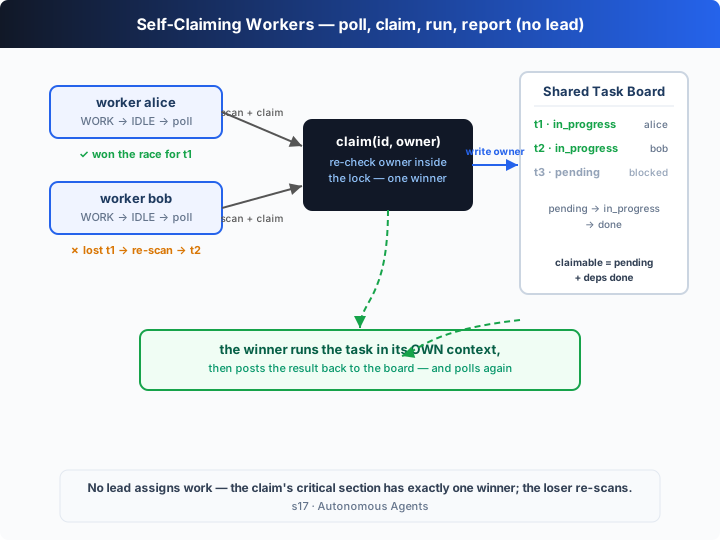
Take the lead out of the assignment loop. Each worker runs a three-phase loop: WORK (run the claimed task) → IDLE (poll the shared task board) → SHUTDOWN (exit when the board is all done). No lead assigns anything; the worker finds its own next task.
The crux is the claim step. The board exposes two operations: an unlocked pure read scan(), and an atomic claim(). The race is part of the design — two workers can absolutely scan() the same pending task in the same instant, so the authoritative "is it still free?" check must live inside claim()'s critical section. The loser concedes honestly and goes back to re-scan.
| concept | meaning | note |
|---|---|---|
scan() | pure read of the board, unlocked | two workers may read the same pending task — the race starts here |
claim(id, owner) | atomic claim: re-checks the task is still free inside the lock, then flips it to in_progress | exactly one winner in the critical section |
| race LOST | claim returns failure (task already taken) | concede honestly, re-scan() for the next one |
dependency blockedBy | not claimable until its dependencies finish | t3 only opens once t1 and t2 are both done |
How It Works
Four pieces: the claimable predicate, the unlocked read, a mutex that makes read-modify-write atomic, and the worker's own loop.
Step 1: what counts as "claimable"? Pending, unowned, and all dependencies done.
private claimable(t: Task): boolean {
  return (
    t.status === "pending" &&
    !t.owner &&
    t.blockedBy.every((id) => this.tasks.get(id)?.status === "done")
  );
}
Step 2: scan() is a pure read, deliberately unlocked. It's fast, but its result may already be stale — the moment you read t1 as free, another worker may be claiming it.
scan(): Task | undefined {
  return this.all().find((t) => this.claimable(t));  // stale the moment it's read
}
Step 3: a promise-chain mutex. Hanging the whole "read-check-modify-write" block on the tail of the chain guarantees only one segment runs at a time — that's the critical section.
class Mutex {
  private tail: Promise<unknown> = Promise.resolve();
  run<T>(fn: () => T | Promise<T>): Promise<T> {
    const next = this.tail.then(fn);
    this.tail = next.catch(() => undefined);
    return next;
  }
}
Step 4: the atomic claim — the heart of this chapter. First a sleep simulates slow storage (that's the race window), then it re-checks inside the lock whether the task is still free. Only the worker that finds it genuinely free wins; everyone else gets an honest "you lost".
async claim(id: string, owner: string): Promise<{ ok: boolean; reason: string }> {
  await sleep(CLAIM_LATENCY_MS);              // the read-then-write gap: where races live
  return this.lock.run(() => {
    const t = this.tasks.get(id);
    if (!this.claimable(t))
      return { ok: false, reason: `already ${t.status} (owner: ${t.owner ?? "none"})` };
    t.owner = owner;
    t.status = "in_progress";                 // re-check passed inside the lock → sole winner
    return { ok: true, reason: "claimed" };
  });
}
Assembled into the worker's full loop:
async function worker(name: string, board: TaskBoard, scratch: string): Promise<void> {
  for (;;) {
    const task = board.scan();
    if (!task) {
      if (board.allSettled()) return;               // SHUTDOWN: the board is all done
      await sleep(POLL_MS);                          // IDLE: keep polling
      continue;
    }
    const res = await board.claim(task.id, name);
    if (!res.ok) continue;                           // race LOST → re-scan
    const result = await runTask(name, task, scratch); // WORK: run it in your own context
    await board.complete(task.id, result);           // post the result back to the board
  }
}
The core insight: scan() gives you a lead, not a promise. It tells you "t1 was free a moment ago", but by the time you reach for it, the world may have changed. So the only check that counts is the re-check inside claim()'s critical section — this is TOCTOU (time-of-check-to-time-of-use). Put the re-check inside the lock and the critical section has exactly one winner, so a double-claim is eliminated structurally. The loser doesn't retry the same task; it just re-scans, and the board naturally has a next one waiting.
Try It
Teaching demo note: the code creates an
s17-scratch-*directory under the system temp dir (os.tmpdir()) and writes each task's artifact file there — it doesn't touch your project files.
No API key needed: this chapter is a self-running demo with no REPL. Without OPENAI_API_KEY it uses a built-in offline scripted model — alice and bob wake at the same time, both scan() t1, and the winner is decided inside claim()'s critical section; the loser moves on to claim t2, narrated throughout.
Setup (first run):
npm install
cp .env.example .env        # fill in OPENAI_API_KEY and MODEL_ID to run the real model
Run:
npx tsx s17_autonomous_agents/code.ts                # offline demo model
OPENAI_API_KEY=sk-... npx tsx s17_autonomous_agents/code.ts   # real model
Try these tweaks:
- Add a third
worker("carol", ...)to thePromise.alland watch three workers split the tasks. - Raise
CLAIM_LATENCY_MSto200to widen the race window and watch morerace LOSTs. - Add an unblocked
t4to the board and watch it get claimed in parallel with t1 and t2.
Watch for: when alice and bob both scan() t1, how does claim() guarantee only one wins? Does the loser actually take the next task (rather than stall or re-grab)? Is t3, blocked by t1+t2, only claimed after both are done?
What's Next
The workers self-organize now, but they still share one working directory. Alice rewrites app.txt for her task; bob rewrites app.txt for his — they clobber each other, and afterwards nobody can say which line belongs to which task.
s18 Worktree Isolation → give every task its own git worktree so parallel workers edit disjoint directories without colliding. This is exactly the Codex Cloud model.
Into the Codex source
The following is based on common multi-worker scheduling architectures, with reference to the overall design of OpenAI's open-source
openai/codexrepo (codex-rs) and of Codex Cloud. The chapter's "atomic claim + self-scan" is the minimal skeleton of an autonomous worker; real implementations make the storage, locking and recovery production-grade.
The chapter's claim() ≈ one atomic claim in a real scheduler. The differences are the real shape of the "lock" and the "board".
1. In-memory mutex vs real atomic primitives
The chapter's Mutex is a promise chain — it holds because Node is single-threaded and the whole board lives in one process's memory. In real systems the board is usually shared storage (a database, files) and the workers are in different processes, even different machines, where an in-process mutex can't reach. So the "re-check inside the lock" is replaced by the storage layer's own atomic primitive: a database UPDATE ... WHERE status='pending' (in a transaction), a compare-and-swap, or a lockfile. The semantics are identical to the chapter's — "re-check + set" must be a single atomic operation — only the mechanism carrying it changes.
2. The race window: simulated here, free in the real world
The chapter uses await sleep(CLAIM_LATENCY_MS) to artificially widen the "gap between read and write" so you can see race LOST even in a small demo. A real scheduler doesn't have to act — network latency and storage round-trips naturally insert a gap between every "read it as free" and "write the claim", so TOCTOU races are the norm, not the exception. The chapter compresses that into one sleep to make the race reproducible and observable; the defense (re-check inside the critical section) is the same in both.
3. Task dispatch in Codex Cloud
In Codex Cloud a "task" runs in its own isolated environment (expanded in s18, next chapter), and a scheduling layer hands queued tasks to free execution slots. The chapter's "worker polls the board and atomically claims" is a minimal replay of that "queue → claim → run → report" loop: in the real system the "board" is shared task storage, the "claim" is an atomic state transition, and a "worker" is an independent execution environment that gets scheduled up. The chapter folds multiple machines and processes into two async workers in a single process, so you can focus on the one thing that matters — a claim must be atomic.
4. Dependencies and recovery
The chapter's blockedBy check (claimable only once all dependencies are done) maps to the plainest edge constraint in a task graph (the s12 task system covers that on its own). Real systems also handle the corners the chapter skips: if a worker dies mid-task, the task must be reclaimed and redelivered (not stuck in in_progress forever); a task may be designed to be claimed at most N times; completion events are persisted so work can resume after a crash. These are hardening layers on top of the "atomic claim" foundation — they don't change the foundation itself.
In one line: autonomy means pushing the "who's free" information down to each worker and backstopping concurrency with a single atomic claim. The chapter uses a promise chain as the critical section and a sleep as the race window to run the whole "scan → claim → run → report" loop in front of you; real systems just move the same semantics into shared storage and independent execution environments.