Approval & Permissions
Tools & ExecutionAsk Before You Act
Codex's approval modes (untrusted / on-failure / on-request / never) are a harness decision point before the shell runs.
s01 → s02 → s03 → s04 → ... → s20
"The model proposes, the policy disposes" — the model suggests; the approval policy decides.
Harness layer: approval — a gate in front of tool execution.
The Problem
The s02 agent has a set of tools, and every call runs the moment it's made. Say "clean up my project" and it might actually run rm -rf.
Safety can't rest on "trusting the model not to misbehave". Models misjudge, get steered by injected malicious content, and read aggressive intent into vague instructions. A reliable boundary has to live in the harness: before a tool executes, decide whether this one needs a human.
But asking for every call is unbearable — confirm every file read and the agent is useless. What's needed is an adjustable trust dial.
The Solution
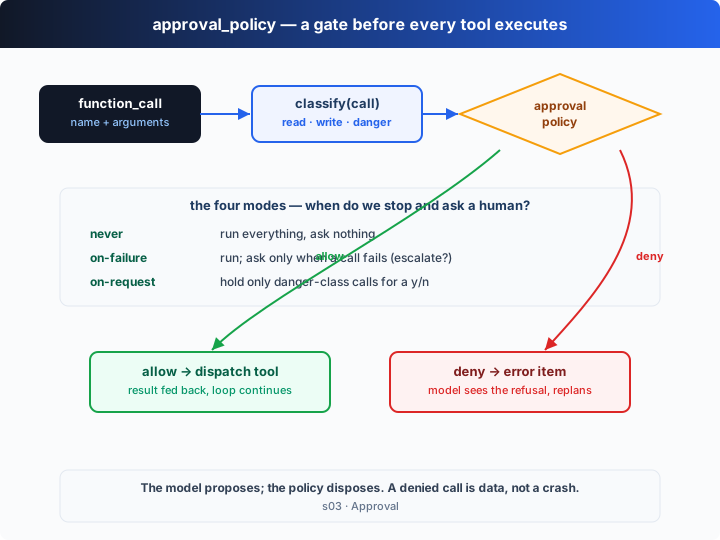
Insert an approval gate in front of dispatch. The harness first classifies each tool call into a risk level (read / write / danger), then the approval_policy decides: run it straight away, hold it for a human, or ask only when it fails.
Codex's approval_policy has four modes — four trust settings:
| mode | meaning | when does it stop and ask a human |
|---|---|---|
never | full trust, ask nothing | never — every call runs |
on-failure | run first, ask on failure | only when a call fails, ask whether to escalate and retry |
on-request | hold only the dangerous | only when a call is classified danger (e.g. rm -rf) |
untrusted | most suspicious, hold by default | anything that isn't a pure read (write / danger / unknown) |
A held call pauses in the REPL, waiting for your y/n. A denial is not a crash: the harness feeds an error item back to the model, which reads "I was denied" and can continue down a safer path.
How It Works
On top of s02's dispatch loop, add exactly one layer: "classify + approval gate".
Step 1: classify — the harness judges risk itself, rather than trusting the model's self-report.
type Risk = "read" | "write" | "danger";
function classify(call: OutputItem): Risk {
  if (call.name === "read_file" || call.name === "list_dir") return "read";
  if (call.name === "shell") {
    const cmd = JSON.parse(call.arguments).command.trim();
    if (DANGER.some((d) => cmd.includes(d))) return "danger"; // rm/sudo/dd/...
    if (READ_ONLY.some((r) => cmd.startsWith(r))) return "read"; // ls/cat/git status/...
    return "write";
  }
  return "write"; // write_file / apply_patch / unknown tools all mutate state
}
Step 2: the policy decision — should this call be held before it runs?
function needsApprovalUpFront(policy: Policy, risk: Risk): boolean {
  switch (policy) {
    case "never":       return false;              // ask nothing
    case "on-request":  return risk === "danger";  // hold only dangerous calls
    case "untrusted":   return risk !== "read";    // hold anything not a pure read
    case "on-failure":  return false;              // run first, ask after a failure
  }
}
Step 3: the gate. If held, ask; if denied, feed an error item back and the loop carries on.
if (needsApprovalUpFront(POLICY, risk)) {
  const ok = await confirm(`hold [${POLICY}] ${call.name} risk=${risk}. Allow?`);
  if (!ok) {
    input.push({ type: "function_call_output", call_id: call.call_id,
                 output: `Error: denied by approval_policy (${POLICY})` });
    continue; // the model sees the denial and picks a safer path
  }
}
let result = dispatch(call.name, call.arguments);
Step 4: on-failure is a different rhythm — nothing is held up front; the ask comes after a failure, offering an escalated retry.
if (POLICY === "on-failure" && result.startsWith("Error")) {
  if (await confirm("call failed [on-failure] retry with approval?")) {
    result = dispatch(call.name, call.arguments); // retry with approval
  }
}
All four policies share one classify; they differ only in when to ask. The key insight: approval is the harness's job, not the model's politeness. The model may propose anything; whether it runs is the policy's call. And a "denial" is just ordinary data to the model — it reads it and keeps reasoning, instead of the whole turn blowing up.
Try It
Teaching demo note: the offline demo has the model attempt an
rm -rf agent_scratch, which the gate holds for your answer. When piping an answer, put they/nafter the task (e.g.printf 'do it\nn\nq\n'). The code only creates/deletesagent_scratch/in the current directory.
No API key needed: the default policy is on-request. The offline model issues a safe write and a dangerous rm -rf in a single turn, so you can see "write allowed, dangerous command held". Flip through all four policies with the env var.
Setup (first run):
npm install
cp .env.example .env        # fill in OPENAI_API_KEY and MODEL_ID to run the real model
Run:
npx tsx s03_approval/code.ts                              # default: on-request
APPROVAL_POLICY=untrusted npx tsx s03_approval/code.ts    # holds the write too
APPROVAL_POLICY=never     npx tsx s03_approval/code.ts    # asks nothing
OPENAI_API_KEY=sk-...     npx tsx s03_approval/code.ts    # real model
Try these prompts:
Create a scratch folder and put a note in it(a write; allowed under on-request, held under untrusted)Delete the scratch folder(rm -rfis classified danger; held for you under on-request)List the files here(a pure read; every policy lets it straight through)
Watch for: with the same set of calls, which get held and which get allowed under each policy? How does a denied call turn into an error item fed back to the model?
What's Next
Approval answers "should it run", but even when you type y, what the command can actually touch is still unrestricted — an approved rm -rf / can still wreck the system. And under on-request, the model asks you every time it writes outside the workspace, which gets tedious.
s04 Sandbox → draw a hard boundary at the execution layer with sandbox_mode: read-only / workspace-write / fully open. Approval governs "do we ask"; the sandbox governs "what can be touched".
Into the Codex source
The following is based on the overall architecture of OpenAI's open-source
openai/codexrepo (codex-rs, written in Rust). The chapter's "classify + four-mode policy + hold-and-ask" is the minimal skeleton of Codex's approval mechanism; the difference is how deeply it couples with the sandbox and the TUI.
The chapter's approval_policy ≈ the approval_policy in Codex's config (set in ~/.codex/config.toml or a profile). Key points from the real implementation below.
1. The four modes are a real enum
Codex models the approval policy as a four-value enum with the same semantics as the chapter: untrusted (most suspicious, asks about almost everything), on-failure (run first, request escalation when the sandbox refuses or a call fails), on-request (the model decides when a human is needed), never (never ask, typical for unattended runs). To keep the focus on "when to ask", the chapter simplifies on-request to "hold only danger" and untrusted to "hold anything not a pure read" — same direction, coarser granularity.
2. Approval and the sandbox are interlocked
The chapter splits approval (here) and the sandbox (s04) into two chapters to keep each one's job clear. In Codex they're two stages on the same execution path: a command first runs under sandbox_mode in a restricted environment; if it needs higher privileges (write outside the workspace, network access) and the current approval_policy allows asking, the harness surfaces an approval and, once granted, re-runs with elevated privileges. In other words, the "failure" in on-failure is very often "the sandbox blocked it". The chapter's "ask whether to retry after a failure" is a simplification of exactly that flow.
3. How you're asked depends on the frontend
The chapter asks with y/n in a REPL. Codex's interactive terminal (TUI) renders an approval panel showing the command and offering choices like "allow / always allow / deny". Non-interactive mode (codex exec, unattended) usually pairs with never, because there's nobody to ask — a command either runs in the sandbox or fails outright. The chapter unifies this path with "a denial feeds an error item back".
4. A denied command is visible to the model
As in the chapter, Codex doesn't blow up the turn on a denial: the refusal returns to context as tool output, and the model reads "the user didn't approve" and can choose a safer alternative, or explain what it was trying to do. That makes approval a conversation, not a wall.
In one line: Codex's approval is a first-class harness responsibility, using the four-mode approval_policy to tune "when to ask a human", and interlocking with the sandbox to decide "with what privileges to re-run once approved". The chapter compresses that chain into "classify → policy → hold-and-ask → denial fed back". Get approval's responsibility boundary solid first; s04 adds the execution boundary (the sandbox).