Error Recovery
Planning & ControlErrors Are the Start of a Retry
A robust harness classifies failures (rate limit, overflow, abort) and decides what kind of retry is worthwhile.
s01 → ... → s10 → s11 → s12 → s13 → ... → s20
"An error is not a crash, it's a classified next step" — back off on rate limits, compact on overflow, stop on abort.
Harness layer: planning — when the main loop hits a failure, classify it first, then decide how to recover.
The Problem
Halfway through a run, the model call throws:
Error: 429 Too Many Requests
s01's naive loop has no protection around callModel() — one thrown exception and the whole turn crashes. No retry, no compaction, no distinction between "wait a second and it'll be fine" and "genuinely hopeless."
But in production, API errors are the norm, not the exception: rate limits (429), overload (529), context overflow (413 / too long), the user hitting Esc to abort. The correct reaction to each is completely different — back off and retry on rate limits, compact then retry on overflow, stop immediately on abort. Treating them all as the same "crash" is like a car that stalls at every speed bump.
The problem isn't that the model is unstable — it's that the harness treats "the call failed" as the end. What it needs is a lookup table from "error" to "recovery path."
The Solution
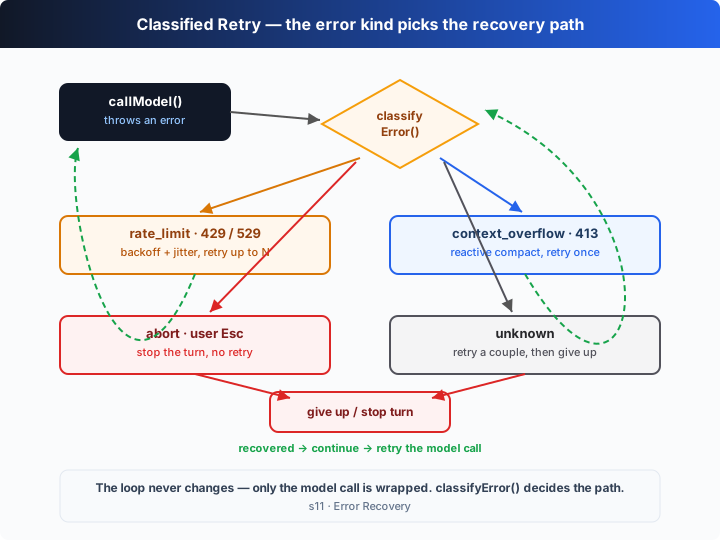
s01's loop stays untouched; we just wrap callModel() in a layer of classified retry. The moment the model call throws, the error goes into classifyError() to be bucketed, and each bucket picks a recovery path. On recovery we continue back to the top of the loop and retry:
| error kind | trigger signal | recovery action |
|---|---|---|
rate_limit | HTTP 429 / 529, "rate limit", "overloaded" | exponential backoff + jitter, retry up to N times |
context_overflow | HTTP 413, "context length", "too long" | reactive compaction (drop oldest turns), retry once |
abort | user Esc / AbortError | abort the current turn immediately, no retry |
unknown | everything else | retry a couple of times, then give up |
The key insight: the recovery strategy is a function of the error kind. The same try/catch should wait on a 429, compact on a 413, and stop on an abort — if you can't tell those three apart, you don't get to call it robust. The backoff formula is the standard min(500 × 2^attempt, 32s) plus 0–25% random jitter, so a fleet of concurrent requests don't all retry at the same instant.
How It Works
Add one wrapper on top of s01's loop, step by step:
Step 1: write a classifier that maps any exception to one of four buckets, using HTTP status, error code, error name, and message text.
type ErrKind = "rate_limit" | "context_overflow" | "abort" | "unknown";

function classifyError(err: unknown): ErrKind {
  const e = err as { status?: number; code?: string; name?: string; message?: string };
  const msg = (e?.message ?? "").toLowerCase();
  if (e?.name === "AbortError" || msg.includes("abort")) return "abort";
  if (e?.status === 429 || e?.status === 529 || msg.includes("rate limit")) return "rate_limit";
  if (e?.status === 413 || e?.code === "context_length_exceeded" || msg.includes("too long"))
    return "context_overflow";
  return "unknown";
}
Step 2: prepare two recovery tools — an exponential-backoff timer, and a minimal reactive compaction (drop the oldest turns to free up context; s08 covers full auto-compaction).
function backoffDelay(attempt: number): number {
  const base = Math.min(500 * 2 ** attempt, 32_000); // cap at 32s
  return base + Math.random() * base * 0.25;         // add 0–25% jitter
}

function compactThread(input: unknown[], keepRecent = 3): void {
  const tail = input.slice(-keepRecent);
  input.length = 0;
  input.push({ role: "user", content: "[compacted] earlier turns summarized" }, ...tail);
}
Step 3: write the wrapper. Inside is a for (;;) that first tries the model call; on a throw it classifies, and per bucket decides to continue (retry) or throw (give up / abort). Each bucket gets its own counter.
async function callModelWithRecovery(input: unknown[]): Promise<OutputItem[]> {
  let rateLimitRetries = 0, unknownRetries = 0, compacted = false;
  for (;;) {
    try {
      return await callModel(input);            // success: return right away
    } catch (err) {
      switch (classifyError(err)) {
        case "abort":    throw err;             // abort: rethrow immediately
        case "rate_limit":
          if (rateLimitRetries++ < 5) { await sleep(backoffDelay(rateLimitRetries)); continue; }
          break;
        case "context_overflow":
          if (!compacted) { compacted = true; compactThread(input); continue; }
          break;
        default:
          if (unknownRetries++ < 2) { await sleep(backoffDelay(unknownRetries)); continue; }
      }
      throw err;                                // out of options: give up
    }
  }
}
Step 4: the loop itself is identical to s01; the only change is swapping the raw call for the wrapped one.
const output = await callModelWithRecovery(input); // ← s11: wrapped, not raw
Core insight: error recovery doesn't change the agent's shape — the loop is the same loop, the tools are the same tools. It just turns "call the model" from a one-shot success-or-die operation into a recoverable attempt. In the offline demo, the scripted model is set up to fail three times first (429 → 529 → context overflow), so you can watch all three recovery paths run, and only on the fourth attempt does it actually get through, run the tool, and wrap up.
Try It
Teaching demo note: the code runs shell commands the model generates (
ls -lain the offline demo). Run it in a scratch directory.
No API key needed: without OPENAI_API_KEY, the chapter's offline scripted model deliberately fails three times first (rate limit, overload, context overflow), running every recovery path in full before it finally succeeds.
Setup (first run):
npm install
cp .env.example .env        # fill in OPENAI_API_KEY and MODEL_ID to run the real model
Run:
npx tsx s11_error_recovery/code.ts                # offline demo model
OPENAI_API_KEY=sk-... npx tsx s11_error_recovery/code.ts   # real model
Try these prompts:
list the files in this directoryshow the current git branchcreate hello.ts that prints "hi"
Watch for: do the first three model calls trigger rate-limit backoff (with growing gaps), overload backoff, and "reactive compact then retry" respectively? Watch the [recovery] logs for the different path each error takes, and note which early turns get dropped during compaction.
What's Next
The agent now survives failure. But it still handles one-shot tasks — you give it a goal, it does it, done. A real project has to be broken into a pile of interdependent sub-tasks: set up the database before you can write the API, write the API before you can test it.
s12 Task System → give the agent a shared task board: create, claim, and complete tasks, declare dependencies, and block work that isn't ready yet. This is also the foundation for the multi-agent collaboration that comes later.
Into the Codex source
The following is based on the overall structure of OpenAI's open-source
openai/codexrepo (codex-rs, written in Rust). The chapter's "classify + retry" is the minimal skeleton of how Codex handles model-call failures; every difference is production-grade streaming detail and state management.
The chapter's callModelWithRecovery ≈ the failure handling in Codex's model client and turn loop. Each item below hardens that core.
1. Backoff retry lives in the model-client layer, not the turn loop
The chapter wraps retry directly around callModel(), glued to the loop. In Codex these two layers are separate: the low-level model client (the part of core that opens the streaming connection to the Responses API) retries transient HTTP errors (429, 5xx) with jittered exponential backoff on its own, and only surfaces an error to the turn loop once retries are exhausted. So "back off on rate limit" is transparent to the layer above — it sees either a successful event stream or an error that has already been retried N times. The chapter flattens this into one layer so the "classify → act" chain is visible at a glance.
2. Context overflow maps to auto-compaction, not just dropping turns
The chapter's compactThread is blunt: it just drops the oldest turns. Codex instead does compaction: when the conversation approaches the model's context window, it has the model summarize the earlier history into one compact item, replaces the original history with that summary, and continues (that's exactly the subject of s08). An API "prompt too long / context overflow" is one signal that triggers this path, but more often the harness compacts proactively based on token usage, before ever hitting the limit. The chapter uses "drop oldest turns" to simulate the "free up context" effect; mechanically it's the same "compact, then retry" road.
3. Abort is first-class and takes a completely different path from errors
The chapter buckets abort separately and rethrows it immediately to stop the current turn. Codex likewise strictly separates a user interrupt (Esc in the TUI) from a genuine error: an interrupt winds the current turn down cleanly — stopping the running model stream and tool execution — while keeping the session alive, so the user can immediately send the next instruction. It is never a candidate for retry, because retrying something the user just cancelled is meaningless. That's exactly why the chapter's abort branch is a throw, not a continue.
4. Streaming makes "when is it a failure" subtler
The chapter treats a model call as a single "returns or throws" unit. Codex is streaming: the model emits events as it generates and the harness dispatches tools as they arrive. So a "failure" can happen mid-stream — the connection drops, an event errors. The client has to decide whether the stream "produced enough to resume from" or "must be restarted wholesale," which is finer-grained than the chapter's whole-call retry. But the recovery philosophy is identical: classify the failure first, then pick the cheapest recovery path for each class.
In one line: Codex's error recovery is, at its core, the chapter's "error kind → recovery action" lookup table. Every extra mechanism — layered retries, auto-compaction, separating interrupts from the session, stream resumption — exists to make that table robust and unobtrusive in a real streaming, long-session environment. Master "classification decides recovery" first; the rest is engineering hardening.