Local Models & Custom Providers
Codex in DepthRun Without OpenAI
The same harness points at a local Ollama/LM Studio model or a compatible gateway by swapping one provider and its wire_api.
s01 → ... → s23 → s24 → s25 → s26 → s27 → s28
"One loop, any backend" —— where the model lives is just one more swappable knob on the harness.
Harness layer: Codex deep-dive — what changes is not the loop, but "which backend the model points at, and which wire protocol it speaks."
The Problem
From s01 to s25, one hidden assumption was never challenged: the model lives at OpenAI. callModel hits api.openai.com, reads its key from OPENAI_API_KEY, and speaks OpenAI's native Responses API.
But in the real world, many people want to tear that assumption down:
- Use a local open-source model — Ollama or LM Studio is running on the machine with a
gpt-oss:20binside. No sending code to the cloud, no API bill — just let Codex work with a model on your own hardware. - Go through a company gateway — the company runs a single LLM gateway (
https://llm.corp.example/v1) that all traffic, auditing, and billing flow through. Codex must point at it, not connect to OpenAI directly. - Plug into a third-party / self-hosted service — some compatible endpoint that may not speak OpenAI's Responses API at all, only the older Chat Completions.
These three share a common thread: the s01 loop has nothing wrong with it — it only cares about "hand my input items to a backend, get output items back." The question is how to make "the model backend" itself a swappable knob: where it points (base_url), what credential it uses (env_key), and which wire protocol it speaks (wire_api). That's not a loop problem — it's the loop's transport layer.
The Solution
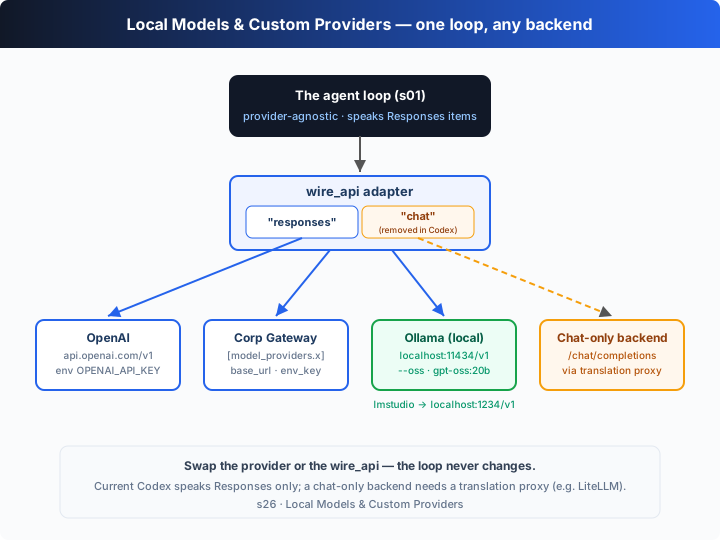
The key insight in one sentence: abstract "the model backend" into a provider registry plus a wire_api adapter. The loop only ever speaks Responses-shaped items; the adapter is the only place that knows which HTTP dialect a given backend speaks. Swap the provider, swap the wire_api — the loop doesn't change a single line.
The two real local paths in the CLI (verified via codex --help):
| flag | what it does |
|---|---|
--oss | use an open-source provider (a local model), not OpenAI |
--local-provider <lmstudio|ollama> | pick which local provider; without --oss, uses the config default or an interactive picker |
-m, --model <MODEL> | choose the model — e.g. gpt-oss:20b on the local path |
Built-in OSS providers (current Codex speaks the Responses wire for both):
| provider | default base_url | notes |
|---|---|---|
ollama | http://localhost:11434/v1 | a local Ollama server; defaults to the Responses endpoint in recent versions |
lmstudio | http://localhost:1234/v1 | local LM Studio; natively supports the Responses API |
The model_providers config table (config.toml — the four knobs of a custom provider):
| key | value | what it does |
|---|---|---|
model_providers.<id>.name | display name | the provider's name |
model_providers.<id>.base_url | URL | the API root (gateway / self-hosted / local) |
model_providers.<id>.env_key | env var name | which environment variable to read the key from (omittable for local providers) |
model_providers.<id>.wire_api | responses | the wire protocol; current Codex only accepts responses (see below) |
A custom id may not reuse the reserved words openai / ollama / lmstudio.
wire_api: responses vs chat — and chat has been removed. Historically wire_api had two values: responses (OpenAI-native, /v1/responses) and chat (the old Chat Completions, /v1/chat/completions, used by many gateways and local servers). But in current codex-rs chat has been removed: setting wire_api = "chat" errors with "no longer supported" and points to discussion #7782. In other words Codex now natively speaks only the Responses API — the local providers (ollama, lmstudio) have both added Responses endpoints; a backend that only speaks chat needs a translation proxy in front of it (e.g. LiteLLM) to turn Responses into chat.
Profiles freeze a provider+model pair into a preset: write model_provider = "ollama" + model = "gpt-oss:20b" into $CODEX_HOME/<name>.config.toml, then codex --profile <name> switches to that backend in one shot (the profile mechanism is covered in s22).
How It Works
Let's translate "a swappable model backend" into TypeScript, step by step:
Step 1: the provider registry. Each entry is exactly the four knobs of model_providers.<id>, plus a local flag (to mark the --oss local path). openai / ollama / lmstudio are built-in reserved words.
interface ModelProviderInfo {
  id: string; name: string; baseUrl: string;
  envKey?: string; wireApi: WireApi; local?: boolean;
}
const REGISTRY: Record<string, ModelProviderInfo> = {
  openai:   { id:"openai", name:"OpenAI", baseUrl:"https://api.openai.com/v1", envKey:"OPENAI_API_KEY", wireApi:"responses" },
  ollama:   { id:"ollama", name:"Ollama (local)", baseUrl:"http://localhost:11434/v1", wireApi:"responses", local:true },
  lmstudio: { id:"lmstudio", name:"LM Studio (local)", baseUrl:"http://localhost:1234/v1", wireApi:"responses", local:true },
};
Step 2: register a custom provider, enforcing two real rules — reserved words can't be reused, and current Codex only accepts responses.
function defineProvider(id, p) {
  if (["openai","ollama","lmstudio"].includes(id))
    throw new Error(`provider id "${id}" is reserved`);
  REGISTRY[id] = { id, ...p };
}
// When real Codex loads config: a non-responses wire_api → "no longer supported"
Step 3: the wire_api adapter — the heart of this chapter. encodeRequest translates a canonical Responses-shaped request into the backend's dialect; decodeResponse translates it back. The chat path translates both ways: function_call → an assistant tool_calls message, function_call_output → a role:"tool" message, and the response's tool_calls back into function_call items.
function encodeRequest(p, req) {
  if (p.wireApi === "responses")
    return { url: `${p.baseUrl}/responses`, body: { model, instructions, input, tools } };
  // chat: translate Responses items into chat.completions messages
  return { url: `${p.baseUrl}/chat/completions`, body: { model, messages: toChat(req), tools: toChatTools(req.tools) } };
}
function decodeResponse(p, raw) {
  if (p.wireApi === "responses") return raw.output;
  const msg = raw.choices[0].message;            // chat → translate back to Responses items
  return [...(msg.tool_calls ?? []).map(toFunctionCall), ...(msg.content ? [toMessage(msg.content)] : [])];
}
Step 4: the agent loop — provider-agnostic, one line unchanged. It only calls callProvider(p, …) and gets canonical items back, with no idea whether it's hitting OpenAI, a company gateway, local ollama, or a chat-only backend.
async function agentLoop(p, task) {
  const input = [{ role: "user", content: task }];
  for (let step = 0; step < 8; step++) {
    const output = await callProvider(p, { model, instructions, input, tools }); // ← the only place that touches transport
    input.push(...output);
    const calls = output.filter((i) => i.type === "function_call");
    if (calls.length === 0) { /* print the final message */ return; }
    for (const call of calls) input.push({ type: "function_call_output", call_id: call.call_id, output: runShell(parse(call).command) });
  }
}
Core insight: the offline demo runs the same task across four providers — openai, a corp gateway, local ollama, and legacy-chat — and prints each wire request. You watch the URL and body shape change with the dialect (/responses carrying input, /chat/completions carrying messages) while the loop, the tool, and the task above it stay identical every single time. The chat path makes the point especially well: the adapter translates Codex's Responses calls into chat — which is exactly what a "translation proxy" (LiteLLM) does, and what older Codex did before chat was removed. What changes is never the loop — it's which backend it points at, and which dialect it speaks.
Try It
Teaching-demo note: this chapter talks to no real backend — the local / custom / chat providers are all simulated by built-in "dialect-aware" scripted backends. It does really
echoa command to prove the loop really executes tools, but it touches no files and sends no network requests. WhenOPENAI_API_KEYis set, only the openai path goes to the real Responses API.
No API key needed: scripted backends drive the loop through all four providers, printing each wire request.
Setup (first run):
npm install
cp .env.example .env        # fill in OPENAI_API_KEY and MODEL_ID to hit real OpenAI
Run:
npx tsx s26_local_models_providers/code.ts                          # offline demo: four providers, one task
OPENAI_API_KEY=sk-... npx tsx s26_local_models_providers/code.ts    # the openai path hits the real API
Try these experiments:
- Just run it and compare the four blocks: openai / corp hit
/responseswithinputin the body; legacy-chat hits/chat/completionswithmessages. The URL and shape change; the loop doesn't. - Look at the ollama block: the model auto-switches to
gpt-oss:20band the base_url islocalhost:11434— a "local model, no OpenAI involved" path. - Note the line at the top of the legacy-chat block:
[real codex] wire_api = "chat" is no longer supported…— that's the real error current Codex raises when loading config; the chat adapter in the demo plays the role of a "translation proxy."
What to watch: across the four blocks, are the $ echo … and the final "Served by …" lines structurally identical? Which two lines are the only things that change (POST <url> and the body shape)?
What's Next
The model backend is swappable now — --oss points at local, model_providers points at a gateway, wire_api handles the dialect. But so far everything we've touched has been "the CLI process": type a command, read the output. Real Codex has another face — being driven as a service by other programs: codex mcp-server turns Codex itself into an MCP server, codex app-server / exec-server expose socket services, and the desktop app and IDE plugins all connect to the same kernel.
s27 Codex as a Service → how the harness goes from "a CLI" to "a set of remotely-drivable services."
Into the Codex source
The following is based on the overall architecture of OpenAI's open-source
openai/codexrepo (codex-rs, the Rust implementation), the official docs, and the--help/codex features listoutput of the locally installedcodex(v0.144.6). The teaching version's "provider registry + wire_api adapter" is the minimal skeleton of this mechanism.
The teaching REGISTRY + encodeRequest/decodeResponse ≈ real Codex's ModelProviderInfo and client construction. Each item below expands on — and verifies — that core.
1. --oss / --local-provider: the built-in local providers
--oss ("Use open-source provider") and --local-provider <lmstudio|ollama> are real flags in codex --help. codex-rs builds in two OSS providers — ollama (default http://localhost:11434/v1) and lmstudio (default http://localhost:1234/v1) — and you can set a default with oss_provider = "ollama" in config.toml. There was once a separate ollama-chat provider that spoke Chat Completions; it has been removed — both local providers now default to the Responses endpoint. The teaching version writes them straight into REGISTRY with local:true, matching this "built-in local backend" design.
2. wire_api: the responses-only turn, and chat's removal
wire_api is defined by the WireApi enum in codex-rs's model-provider-info crate. Historically it had Responses and Chat variants; the current version keeps only Responses. Setting wire_api = "chat" produces the hard error "wire_api = "chat" is no longer supported. How to fix: set wire_api = "responses"" (pointing to discussion #7782; chat was deprecated in Dec 2025 and removed in Feb 2026). The teaching version keeps the chat adapter and prints this real error to demonstrate the "translation proxy" role — in reality a chat-only backend relies on a proxy like LiteLLM to translate Responses into chat; Codex itself no longer does this.
3. The full ModelProviderInfo field set
Beyond the name/base_url/env_key/wire_api the teaching version shows, the real ModelProviderInfo carries network details like request_max_retries (default 4), stream_max_retries (default 5), stream_idle_timeout_ms, http_headers, env_http_headers, and query_params. A custom provider id may not reuse the reserved words openai / ollama / lmstudio. These were all verified in s22's config deep-dive, and this chapter reuses the same conclusions.
4. Profiles and the boundary of project-level config
--profile <name> layers $CODEX_HOME/<name>.config.toml on top of the base config, and a preset can set model_provider + model to switch to a backend in one shot (e.g. a "local ollama" preset). Note the boundary: project-level .codex/config.toml cannot set provider-routing keys (model_provider, model_providers, oss_provider, etc.) — those only live in the user-level ~/.codex/config.toml. In other words, "which backend the model points at" is a machine-level decision; a project has no say.
In one sentence: local models, company gateways, and third-party endpoints are not new agents — they're the same loop with a different "transport layer." Almost all the complexity in the real implementation is engineering — default ports for built-in providers, the responses-only turn of wire_api, provider retries/headers/query params, and the boundary between profiles and project-level config — not the loop itself. Once you internalize "a registry plus a dialect-translating adapter, with the loop unchanged," you've seen through the whole mechanism.