Skills
Planning & ControlLoad Expertise Only When Needed
Codex skills inject specialized instructions only when the task actually needs them.
s01 → s02 → s03 → s04 → s05 → s06 → s07 → s08 → ... → s20
"Load knowledge on demand, not all up front" — inject the manual into the context only when you need it.
Harness layer: planning — load knowledge on demand, don't cram the context full.
The Problem
Your project has a React component style guide, a SQL style guide, and a Conventional Commits format. You want the agent to follow them automatically. The most direct idea is to cram them all into the system prompt:
const INSTRUCTIONS =
  "You are a coding agent. " +
  read("docs/react-style.md") +      // 2000 lines
  read("docs/sql-style.md") +        // 1500 lines
  read("docs/commit-format.md");     // 800 lines
Four thousand-odd lines of system prompt. The agent carries all of these documents on every single call — whether it's changing a CSS color or writing a SQL query. 99% of it has nothing to do with the current task, yet it burns tokens every turn and dilutes the instructions that actually matter.
The knowledge is needed, but carrying all of it all the time is wrong. That isn't how people deal with documentation either: you don't memorize the whole wiki — you first learn "there's a guide for that," then go read it when the need arises.
The Solution
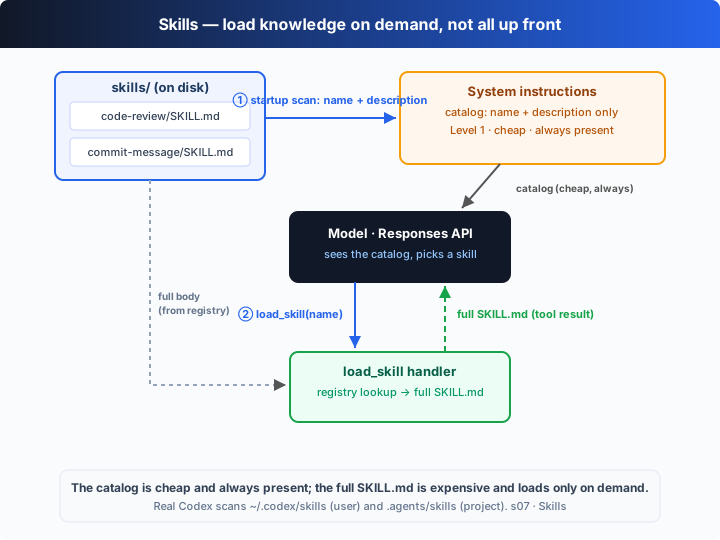
Turn knowledge into skills: a SKILL.md file whose opening YAML frontmatter declares a name and a description, with the full rules in the body. The harness does two-level loading:
| level | content | when it enters the context | cost |
|---|---|---|---|
| ① catalog | each skill's name + description | scan skills/ at startup, fold into the system prompt | a few tokens per skill, present every turn |
| ② body | the entire SKILL.md rules | when the task matches, the model calls load_skill(name) | thousands of tokens, paid only when needed |
The model sees "which skills I have" every turn (the cheap catalog) but memorizes no body. Only when it decides "this task needs the commit format" does it make one load_skill call, injecting that full manual as a function_call_output — as naturally as reading a file.
The key: the body is not part of the system prompt — it is a tool result. You pay for it when you use it, and pay nothing when you don't.
How It Works
Add a "scan + load" mechanism on top of the s01 loop, step by step:
Step 1: at startup, scan the skills/ directory, parse each SKILL.md's frontmatter, and register only the name + description (the body is kept in memory, not in the prompt).
type Skill = { name: string; description: string; content: string };
const SKILL_REGISTRY = new Map<string, Skill>();

function scanSkills(): void {
  for (const dir of subdirsOf(SKILLS_DIR)) {
    const raw = fs.readFileSync(path.join(dir, "SKILL.md"), "utf8");
    const meta = parseFrontmatter(raw);            // read name / description
    SKILL_REGISTRY.set(meta.name, { name: meta.name, description: meta.description, content: raw });
  }
}
scanSkills(); // runs once, at startup
Step 2: fold the catalog (not the bodies) into the system prompt. The model sees the available skills every turn, at negligible cost.
const INSTRUCTIONS =
  `You are a coding agent. Available skills:\n` +
  [...SKILL_REGISTRY.values()].map((s) => `- ${s.name}: ${s.description}`).join("\n") +
  `\nWhen the task matches a skill's description, call load_skill to fetch its full instructions.`;
Step 3: the load_skill tool fetches the full body from the registry by name. Going through the registry rather than a file path means the model only ever supplies a key — no path-traversal risk.
function loadSkill(name: string): string {
  const skill = SKILL_REGISTRY.get(name);
  if (!skill) return `Skill not found: ${name}.`;
  return skill.content;                            // the full SKILL.md returned as a tool result
}
Step 4: dispatch on the tool name in the loop. The body returned by load_skill is fed back into the thread as a function_call_output, and the model then works by its rules.
if (call.name === "load_skill") {
  result = loadSkill(args.name);     // inject the full skill manual
} else {
  result = runShell(args.command);   // do the real work
}
input.push({ type: "function_call_output", call_id: call.call_id, output: result });
Assembled: startup → scan the catalog into the system prompt → the model sees the task match a skill → calls load_skill → the full rules enter the context → it follows them. This chapter ships two example skills (code-review, commit-message), and the offline demo acts out the whole "match → load → follow" flow.
Core insight: a skill is not "a bigger system prompt" — it turns knowledge from a fixed cost into an on-demand cost. The catalog tells the model what exists; the body tells it how to do it. The former is cheap enough to carry every turn; the latter is expensive enough to pay for only when truly needed.
Try It
Teaching demo note: this chapter reads two example skills (
code-review,commit-message) froms07_skills/skills/. The offline demo runsgit status --shortto show "load the skill, then follow it."
No API key needed: without OPENAI_API_KEY, the built-in offline model decides which skill the task matches, calls load_skill to inject the full rules, then runs one command by those rules to wrap up.
Setup (first run):
npm install
cp .env.example .env        # fill in OPENAI_API_KEY and MODEL_ID to run the real model
Run:
npx tsx s07_skills/code.ts                # offline demo model
OPENAI_API_KEY=sk-... npx tsx s07_skills/code.ts   # real model
Try these prompts:
Review my changes(matchescode-review)Write a commit message for what's staged(matchescommit-message)What skills are available?(reads the catalog only, no body loaded)
Watch for: how many skills does it print as scanned at startup? Does [skill loaded] appear when the task matches? Does the full SKILL.md enter the context only after you need it (rather than sitting in the system prompt from the start)?
What's Next
On-demand loading solves "don't carry what you shouldn't carry up front." But another problem appears: after the agent works for half an hour, the message list is stuffed with intermediate steps — stale tool results, outdated file contents — squatting on context without producing value.
s08 Context Compact → auto-compact when the context fills up: summarize the older turns into one compact item, freeing space to keep going.
Into the Codex source
The following is based on the overall structure of OpenAI's open-source
openai/codexrepo (codex-rs, written in Rust). The chapter's "scan a catalog + load on demand" is the minimal skeleton of Codex's skill mechanism; the loading and injection logic lives mostly on the core side, and this capability is still evolving quickly — what follows is an architecture-level comparison.
The chapter's load_skill ≈ Codex's skill loading. Each item below extends that core.
1. Skill sources: more than one skills/ directory
The chapter scans a single local skills/. Codex discovers skills from several locations, layered by scope: ~/.codex/skills is user-level (applies to every project), .agents/skills inside a project is project-level (applies to that repo only), and built-in skills sit alongside them. The sources are merged and de-duplicated into one catalog. The chapter uses a single directory to show "discover skills from disk"; the layering and merging are left for you to map onto the real implementation.
2. Frontmatter: name + description are the catalog's keys
The chapter parses only the name and description fields — exactly the minimum a skill needs to be listed in the catalog: the name to call it by, the description so the model can judge "when should I use this". The real implementation's frontmatter is richer (and evolves across versions), but name / description remain the core of the catalog layer. The chapter's parseFrontmatter deliberately takes just those two.
3. The essence of two-level loading: from fixed cost to on-demand cost
Codex's system prompt already carries a fair amount (built-in instructions, AGENTS.md, and so on — see s10). Folding every skill body in as well would bloat it without bound. The skill mechanism's answer matches the chapter: the catalog is resident, the body is on demand — the model first sees a cheap list of skills and pulls the full manual into the context only when it decides it needs one. The chapter reproduces this path with "load_skill returns the body as a function_call_output"; once the body is in history it rides along like any tool result until it is compacted (see s08) or the session ends.
4. Skills vs. AGENTS.md: resident instructions vs. on-demand knowledge
AGENTS.md (s10) is a resident project-level instruction — conventions like coding standards and build commands that "always apply" and should be present every session. A skill is on-demand expertise — a procedure only a certain kind of task needs. The two complement each other: put "always obey" rules in resident instructions, and make "needed only sometimes" knowledge a skill loaded on demand. This chapter covers only the skills half; assembling resident instructions is left for s10.
In one line: Codex's skill mechanism is, at its core, "scan a catalog at startup → the model loads bodies on demand". The real sources, frontmatter fields, and injection details are richer, but the trunk — "the catalog is cheap and resident, the body is expensive and on demand" — stays the same. See the trunk clearly first and the details unfold on their own.