The Full Harness
Multi-Agent PlatformAll Mechanisms, One Loop
The final harness is still one loop, now surrounded by the systems that make it production-shaped.
"Many mechanisms, one loop." — tools, approval, sandbox, plan, memory, sub-agents and MCP all hang off the same loop.
Harness layer: collaboration — folding the previous 19 chapters back into one runnable system.
The Problem
Each of the last 19 chapters added exactly one mechanism to the loop. That's the clearest way to learn, but a real Codex agent never goes to work carrying just one.
A coding agent that works for hours needs all of these at once: a set of structured tools, an approval gate, a sandbox, a self-updating plan, sub-agents it can delegate to, an MCP bridge to external tools, and memory it can resume from.
The hard part isn't piling them together — it's seeing where each one hangs on the loop: which are tools inside the loop? Which are layers wrapped around dispatch? Which wrap the model call itself?
This chapter invents no new mechanism. It does one thing: treats every earlier mechanism as a composable layer, fits them all back onto the for (;;) from s01, then runs a narrated trace so you can watch each layer fire — and watch it say "no."
The Solution
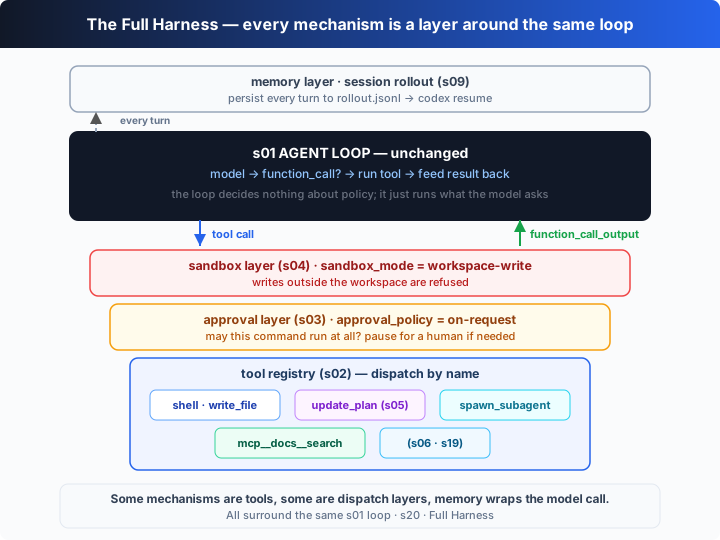
The key insight: these mechanisms do not all live on the same layer. To the loop, they come in three kinds — tools in the registry, layers around dispatch, and a layer around the model call. They all surround the same loop; none of them change it:
| mechanism | from | where it hangs | what it does |
|---|---|---|---|
| tool registry | s02 | inside the loop (dispatch core) | dispatches structured tools by name (shell / write_file / …) |
update_plan | s05 | a tool in the registry | lets the model maintain a live checklist as it works |
spawn_subagent | s06 | a tool in the registry | runs a child loop with a fresh context, returns only its summary |
mcp__docs__* | s19 | bridged tools in the registry | exposes an external MCP server's tools as mcp__<server>__<tool> |
| approval | s03 | a layer around dispatch | every command passes approval_policy; pause for a human when needed |
| sandbox | s04 | an outer layer around dispatch | sandbox_mode decides whether a write may leave the workspace |
| memory / rollout | s09 | a layer around the model call | appends every turn to rollout.jsonl; codex resume can reload it |
So the whole harness is three concentric layers: the registry at the core, approval / sandbox wrapping dispatch, memory wrapping the model call — and in the very center, still the s01 loop.
How It Works
Step 1: start by admitting a fact — the loop itself hasn't changed by a single line. It's the same for (;;) from s01; the only "seam" is that tool calls are handed to a thing called dispatch:
async function agentLoop(input: unknown[], isChild = false): Promise<string> {
  const model = isChild ? callChildModel : callModel;
  for (;;) {
    const output = await model(input);
    input.push(...output);
    const calls = output.filter((i) => i.type === "function_call");
    if (calls.length === 0) return extractText(output);   // no tool calls → done

    for (const call of calls) {
      const args = JSON.parse(call.arguments ?? "{}");
      const result = await dispatch(call.name ?? "", args);   // ← the only seam
      input.push({ type: "function_call_output", call_id: call.call_id, output: result });
    }
  }
}
Step 2: the first kind of mechanism is just a tool in the registry. s02's registry does two things — advertise tools to the model, and dispatch them by name:
const TOOLS: FnTool[] = [];
const REGISTRY = new Map<string, Handler>();
function register(tool: FnTool, handler: Handler): void {
  TOOLS.push(tool);                 // advertised to the model
  REGISTRY.set(tool.name, handler); // dispatched by name
}
update_plan (s05), spawn_subagent (s06), and the MCP-bridged mcp__docs__search (s19) all look identical to the loop: a name plus a handler. The MCP bridge just renames a remote tool and registers it:
const bridged = fn(`mcp__${server}__${t.name}`, `(MCP:${server}) ${t.description}`, t.parameters);
register(bridged, (args) => s.call(t.name, args));
Step 3: the second kind doesn't live in the registry — it's a layer wrapped around dispatch. Approval (s03) and sandbox (s04) are each a higher-order function: take a dispatch, return a stronger dispatch.
type Dispatch = (name: string, args: Record<string, any>) => Promise<string>;

const withApproval = (next: Dispatch): Dispatch => async (name, args) => {
  if (classify(name, args) === "ask") {
    return "Error: approval_policy=on-request and the operator denied this command";
  }
  return next(name, args);
};

const withSandbox = (next: Dispatch): Dispatch => async (name, args) => {
  const target = writeTarget(name, args);
  if (target && !target.startsWith(WORKSPACE + path.sep)) {
    return `Error: sandbox_mode=workspace-write refused to write outside ${WORKSPACE}`;
  }
  return next(name, args);
};
Compose them — registry at the core, wrapped first by approval, then by sandbox (the outermost layer speaks first):
const baseDispatch: Dispatch = async (name, args) => {
  const handler = REGISTRY.get(name);
  if (!handler) return `Error: unknown tool "${name}"`;
  return handler(args);
};
const dispatch = withSandbox(withApproval(baseDispatch));
Step 4: the third kind wraps even further out — it wraps the model call, not dispatch. Memory (s09) is exactly that wrapper: on every turn, append the output to rollout.jsonl first, then hand it back to the loop.
type ModelFn = (input: unknown[]) => Promise<OutputItem[]>;
const withMemory = (next: ModelFn): ModelFn => async (input) => {
  const output = await next(input);
  fs.appendFileSync(ROLLOUT, output.map((i) => JSON.stringify(i)).join("\n") + "\n");
  return output;
};
So one tool call's full journey is memory → loop → sandbox → approval → registry, and back again. Whichever layer says "no", its error is fed back as an ordinary function_call_output — the loop doesn't stop, and the model thinks up the next step. That is the entire capstone: adding a mechanism never means changing the loop; it means wrapping one more layer onto these fixed seams.
Try It
Teaching demo note: this chapter builds its workspace in an isolated temp directory (the sandbox root) and writes
notes.mdandrollout.jsonlthere — it never touches your repo. The sandbox refusing to write outside the workspace is exactly it doing its job.
No API key needed: without OPENAI_API_KEY, a scripted offline model issues just one tool call per turn, so the narrated trace lights up each layer exactly once — approval refuses once, the sandbox refuses once, a sub-agent runs once, MCP answers once.
Setup (first run):
npm install
cp .env.example .env        # fill in OPENAI_API_KEY and MODEL_ID to run the real model
Run (self-running demo, no input needed):
npx tsx s20_full_harness/code.ts                # offline scripted model — watch each layer fire
OPENAI_API_KEY=sk-... npx tsx s20_full_harness/code.ts   # real model, same layers around live output
Three ways to play:
- Run the offline demo and read the narration line by line: which lines are the loop talking (
⚙and the final answer), and which are the layers ([approval]/[sandbox]/[plan]/[mcp]/[subagent]/[memory]). - Set a real
OPENAI_API_KEYand run again: the offline script is bypassed, butdispatch,withMemoryand the whole layered structure wrap the live model's output unchanged. - Change one thing and re-run: swap the hardcoded
taskinmain(), or tweakclassify()/writeTarget(), and watch the allow/deny decisions of approval and sandbox shift.
Watch for: approval and the sandbox each say "no" once, yet the loop never stops — the error is fed back as an ordinary result and the model carries on. That is "many mechanisms, one loop."
What's Next
This is the end of the book, and also a beginning: from s01 to here the code looks more and more complex, yet the core never changed. Pick any chapter's mechanism and re-run it with a real key; or point this assembled harness at your own repository and watch how the layers fire on your real tasks. Beyond that, go read the real openai/codex source — you can now recognize which chapter each layer inside it belongs to.
Into the Codex source
The following is based on the overall structure of OpenAI's open-source
openai/codexrepo (codex-rs, written in Rust). The teaching version composes mechanisms into layers with a few higher-order functions; Codex's production build writes the same layering into its core turn pipeline. The differences are engineering robustness, not architecture.
1. The loop itself: the turn loop in core
The chapter's agentLoop corresponds to the turn loop that drives one round in codex-rs/core (run_turn / try_run_turn). The difference: Codex consumes a stream of events — the model emits ResponseItems as it generates, and the harness dispatches a tool call as soon as it's complete rather than waiting for the whole turn. But the condition matches the chapter: whether this turn still contains a tool call decides whether to continue. Every call the loop makes into approval, sandbox and memory hangs off the same seams as in the teaching version.
2. The dispatch pipeline ≈ Codex's tool-execution pipeline
The chapter's withSandbox(withApproval(baseDispatch)) is a real execution pipeline in Codex: a tool call first passes approval_policy (untrusted / on-failure / on-request / never) — on-request makes the TUI pop an approval prompt and wait for a human y/n — and only then does the command run inside the sandbox backend, its output returning to the thread as a function_call_output. The chapter replaces the interactive prompt with a "demo auto-answers no"; the order and semantics are unchanged.
3. The sandbox backend: the chapter checks a path, the real thing uses the OS
The chapter's withSandbox does a single string-prefix check on write_file. Codex's sandbox_mode (read-only / workspace-write / danger-full-access) is enforced by OS-level isolation: Seatbelt on macOS (sandbox-exec policy), Landlock / seccomp on Linux. So the real sandbox applies to every exec, not just one tool, and a violation is blocked by the kernel, not by a string match. codex-rs additionally has an execpolicy-style policy layer that classifies commands into allow / prompt / deny.
4. The tool registry ≈ openai_tools + the MCP namespace
The chapter's REGISTRY corresponds to how Codex advertises tools to the model and dispatches them by name: shell, apply_patch and update_plan are built-in first-class tools (update_plan really exists — the model calls it to maintain a todo list that the TUI renders live); MCP tools come from the mcp_servers block in ~/.codex/config.toml, are connected over stdio JSON-RPC by a connection manager, listed, and merged into the tool pool under the name mcp__<server>__<tool>. The chapter substitutes an in-process mock server for the stdio transport; the naming and dispatch are the same.
5. Memory / rollout ≈ RolloutRecorder and codex resume
The chapter's withMemory appends each turn's output to rollout.jsonl. Codex's rollout recorder (RolloutRecorder) does the same thing: it persists every ResponseItem to ~/.codex/sessions/.../rollout-*.jsonl, so codex resume / codex exec resume can reload the thread and continue from the checkpoint. The chapter only appends the model's output items, where the real one also records session metadata and events — but the "persist every turn, reloadable" pattern is the same.
6. What the chapter simplified (an honest list)
To keep the demo runnable offline and focused on layering itself, this chapter made these simplifications:
- Sub-agents use an in-process child loop (fresh context, summary-only return) to demonstrate the general pattern; Codex's own sub-agent / multi-agent capabilities are still evolving, and cloud tasks isolate work with git worktrees (see s18).
- MCP uses an in-process mock server, dropping the stdio JSON-RPC transport; the bridging, naming and dispatch are real.
- Approval auto-answers instead of showing an interactive prompt; the classify and allow/deny branches are real.
- Sandbox only does a path-prefix check; real Seatbelt / Landlock is kernel-level and applies to every command.
All these simplifications share one principle: the position of each layer and the loop's seams are real; the inside of each layer is swapped for a teaching version.
In one line: Codex's production harness is not "another, smarter brain" — it's a mature set of concentric layers: tools at the core, approval and sandbox wrapping execution, memory wrapping the model call, and in the very center still the loop that hasn't changed since s01.