Review, CI & Cloud
Codex in DepthThe Harness Leaves Your Laptop
codex review, codex exec in CI, and Codex Cloud tasks are the same loop running unattended on real work.
s01 → ... → s20 → s21 → s22 → s23
"The harness leaves your laptop" — the same agent loop, handed to scripts, CI and the cloud to run unattended.
Harness layer: Codex in depth — what changes isn't the loop, it's who drives it, what it points at, and how the result comes back.
The Problem
From s01 to s20 we rebuilt a Codex-style harness one mechanism at a time; in Part II, s21 walked the real CLI's command surface and s22 resolved every knob in config.toml. But one assumption has never been broken: the loop is driven by a person sitting at a keyboard — you type a prompt, watch it run turn by turn, and approve each command by hand.
Real teams want the opposite: "it has to run even when nobody is watching":
- Have it read code, not just write it — point the agent at a diff and get prioritized review comments back, ideally automatically on every PR, instead of begging it in a chat box.
- Embed it in scripts and CI — run a task in a shell script or a GitHub Action and consume the result programmatically, not read a chat transcript. Chat text is friendly to humans and a disaster for scripts.
- Have it run for you offline — delegate a task; it runs itself in an isolated cloud environment, you close your laptop and go to a meeting, and come back to a PR that's already open.
These three share one thing: the s01 loop is perfectly fine — the question is how to make the same loop run unattended, on real work, and hand back a machine-usable result. That's not a loop problem; it's a problem of the loop's driver and its exit.
The Solution
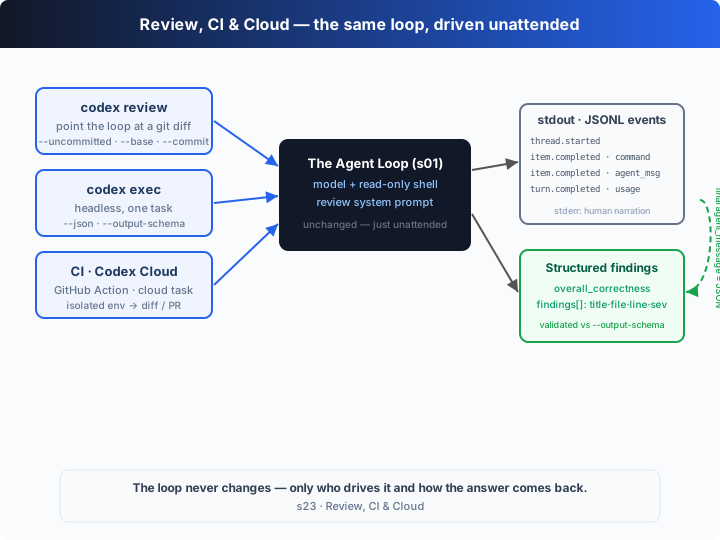
The key insight in one line: codex review, codex exec in CI, and Codex Cloud tasks are the same loop — only three things change: who drives it (a person / a script / CI / the cloud), what it points at (a diff / a task / a delegated task), and how the result comes back (inline comments / a JSONL event stream + schema-conforming JSON / a PR).
| Form | Real command | Driven by | Points at | Result comes back as |
|---|---|---|---|---|
| Review mode | codex review [--uncommitted|--base B|--commit SHA] | person / script | a git diff | prioritized findings (inline comments; doesn't touch your tree) |
| Headless exec | codex exec --json --output-schema s.json "task" | script / CI | a task | a JSONL event stream on stdout + a schema-conforming final message |
| Cloud task | codex cloud exec | status | diff | apply | the cloud (hosted) | a delegated task | a diff / PR produced in an isolated environment |
The review scope of codex review (real flags, a top-level subcommand that also exists as codex exec review):
| flag | What it reviews |
|---|---|
--uncommitted | all staged + unstaged + untracked changes in the working tree |
--base <BRANCH> | the diff of the current branch against the merge-base of a base branch |
--commit <SHA> | the set of changes introduced by one commit |
[PROMPT] or - | a custom review instruction; - reads it from stdin |
--title <TITLE> | a commit title shown in the review summary |
Review is read-only: it reports "prioritized, actionable findings" as inline comments attached to specific diff lines, and does not modify your working tree.
How It Works
Translate "unattended review" into TypeScript. The pipeline: build a buggy diff → run headless exec with a review system prompt + --output-schema → stream the run to stdout as JSONL → parse out structured findings.
Step 1: build the review target. In a temp dir, git init, commit a correct base, then write an uncommitted change — git diff gives exactly what codex review --uncommitted would see. This change hides three regressions you can spot from the diff alone.
function buildSampleRepo(): string {
  const repo = path.join(fs.mkdtempSync(path.join(os.tmpdir(), "s23-")), "repo");
  fs.mkdirSync(path.join(repo, "src"), { recursive: true });
  git(repo, "init -b main");
  // …config user.* …
  fs.writeFileSync(path.join(repo, "src", "login.ts"), BASE_TS);
  git(repo, "add -A");
  git(repo, 'commit -m "base login helpers"');
  fs.writeFileSync(path.join(repo, "src", "login.ts"), BUGGY_TS); // uncommitted change
  return repo;
}
const diff = git(repo, "diff"); // uncommitted → maps to `codex review --uncommitted`
Step 2: the review system prompt + --output-schema. The prompt constrains the agent to be a "read-only reviewer" — it may open files for context but must never edit them, and it returns only one JSON object. The schema pins the "final message" to a shape a script can depend on (this is exactly what codex exec --output-schema does).
const REVIEW_INSTRUCTIONS =
  `You are Codex running in review mode. You are given a unified git diff. ` +
  `Find real, prioritized problems … Use the shell only to read context; NEVER edit files. ` +
  `When done, reply with ONLY a JSON object matching the provided schema.`;

const FINDINGS_SCHEMA = {
  type: "object", required: ["overall_correctness", "findings"],
  properties: {
    overall_correctness: { type: "string", enum: ["patch is correct", "patch is incorrect"] },
    findings: { type: "array", items: { type: "object",
      required: ["title", "body", "file", "line", "severity"],
      properties: { title: {…}, body: {…}, file: {…}, line: {…},
        severity: { type: "string", enum: ["low", "medium", "high"] } } } },
  },
};
Step 3: the --json event stream. In headless mode each line of JSON goes to stdout; human narration goes to stderr, so stdout can be piped straight to a file or jq. The event types match the real codex exec --json.
function emitEvent(type: string, extra: Record<string, unknown> = {}): void {
  console.log(JSON.stringify({ type, ...extra })); // stdout = the machine channel
}
The real codex exec --json event and item types:
| event.type | meaning |
|---|---|
thread.started | session started, with thread_id |
turn.started | a turn started |
item.started / item.completed | an item (tool call / message) started / completed, with the item object |
turn.completed | a turn finished, with usage (input/output/reasoning tokens) |
turn.failed / error | failure / error |
Item type values: command_execution · agent_message · reasoning · file_change · mcp_tool_call · web_search · plan_update.
Step 4: the headless executor codexExec — the heart of this chapter. It runs a task to completion with no human in the loop; with json: true it streams each turn's tool calls and the final message as JSONL; finally it returns the final agent message (the structured payload).
async function codexExec(prompt: string, opts: ExecOptions): Promise<string> {
  if (opts.json) emitEvent("thread.started", { thread_id: `thr_${Date.now().toString(36)}` });
  if (opts.json) emitEvent("turn.started");
  const input: unknown[] = [{ role: "user", content: prompt }];
  let finalText = "";
  for (let step = 0; step < 8; step++) {
    const output = await callModel(input, opts);            // a Responses call carrying the schema
    input.push(...output);
    const calls = output.filter((i) => i.type === "function_call");
    if (calls.length === 0) {                                // the model is done: final message
      for (const item of output)
        if (item.type === "message")
          for (const c of item.content ?? [])
            if (c.type === "output_text" && c.text) finalText += c.text;
      if (opts.json) emitEvent("item.completed", { item: { id: `item_${++itemSeq}`, type: "agent_message", text: finalText } });
      break;
    }
    for (const call of calls) {                              // tool call → command_execution item
      const { command } = JSON.parse(call.arguments ?? "{}") as { command: string };
      const result = runShell(opts.cwd, command);
      if (opts.json) emitEvent("item.completed", { item: { id, type: "command_execution", command, status: "completed", aggregated_output: result.slice(0, 400) } });
      input.push({ type: "function_call_output", call_id: call.call_id, output: result });
    }
  }
  if (opts.json) emitEvent("turn.completed", { usage: approxUsage(input) });
  return finalText;
}
Note codexExec's signature: { instructions, cwd, json, schema }. It knows nothing about "review" — review is just exec with a different system prompt, a diff stuffed into the prompt, and a schema attached. That is exactly this chapter's thesis:
const finalMessage = await codexExec(promptWithDiff, {
  instructions: REVIEW_INSTRUCTIONS, cwd: repo, json: true, schema: FINDINGS_SCHEMA,
});
const review = parseFindings(finalMessage); // validate and parse the findings
When running the real model, the schema constrains generation directly through the Responses API's Structured Outputs (text.format = { type: "json_schema", … }) rather than validating after the fact.
The headless flags of codex exec (real):
| flag | meaning |
|---|---|
--json | stream the run to stdout as a JSONL event stream |
--output-schema <FILE> | constrain the final message with a JSON Schema (Structured Outputs) |
-o, --output-last-message <FILE> | write the final agent message to a file (and still print it) |
--color <always|never|auto> | whether to colorize output (default auto) |
-C, --cd <DIR> | the working root directory for the agent |
-s, --sandbox <MODE> | read-only / workspace-write / danger-full-access |
-m, --model / -p, --profile / -c key=value | override model / profile / any config key |
--skip-git-repo-check · --ephemeral | run outside a git repo · don't persist the session |
Wiring into CI: openai/codex-action
There's nothing new in CI — it's "run codex exec on some runner". The official Action openai/codex-action@v1 installs the CLI for you, sets up a secure proxy to the Responses API, and wraps permission controls around codex exec:
| input | purpose |
|---|---|
openai-api-key (required) | the key for the Responses API proxy, stored as a GitHub secret |
prompt / prompt-file | the task, inline or from a file |
permission-profile | e.g. ":read-only" / ":workspace", controlling filesystem and network |
safety-strategy | drop-sudo (default) / unprivileged-user / read-only / unsafe |
output-file · working-directory · model · effort · codex-args | output target, working dir, model, reasoning effort, extra CLI args |
(output) final-message | the final agent message — the next step can post it as a PR comment |
A minimal "auto-review on every PR" workflow: actions/checkout pulls the code → openai/codex-action@v1 runs with openai-api-key + a review prompt → github-script posts the final-message output as a PR comment.
Delegating to the cloud: Codex Cloud
Codex Cloud moves the same loop into an isolated cloud environment: each task gets its own container / micro-VM, clones your repo, first runs your configured setup script (install deps, inject variables and secrets, open the network per policy), the agent works autonomously inside while you watch logs live or send it to the background; when done it returns a summary + diff, and you can ask for rework or open a PR with one click. From the CLI you drive it with codex cloud:
| subcommand | purpose |
|---|---|
codex cloud exec | submit a new cloud task without opening the TUI |
codex cloud status / list | check the status of one / all cloud tasks |
codex cloud diff | view the unified diff produced by a cloud task |
codex cloud apply | apply a cloud task's diff to your local working tree (see also codex apply <TASK_ID>) |
Core insight: the loop hasn't changed since s01. Review mode = exec + a review prompt + a diff + a schema; headless = remove the "person" from the driver's seat and swap the result from "chat text" to "a machine-readable event stream on stdout"; CI and Cloud = run the same exec on someone else's runner / container. What changes is never the loop, but who sits in the driver's seat, where the wheel points, and what the finish line hands back.
Try It
Teaching demo note: the code
git inits a real git repository in the system temp dir (os.tmpdir()), commits a base, writes an uncommitted change with 3 bugs, then runs a headless review on it. Everything happens in the temp dir and never touches your project.
No API key needed: this chapter is a self-running demo with no REPL. Without OPENAI_API_KEY it uses a built-in scripted "reviewer" — it first runs cat -n src/login.ts to see line numbers, then returns findings as schema-conforming JSON; the whole time it prints a codex exec --json-style event stream to stdout and human narration to stderr.
Setup (first run):
npm install
cp .env.example .env        # fill in OPENAI_API_KEY and MODEL_ID to run the real model
Run:
npx tsx s23_review_ci_cloud/code.ts                       # offline demo (machine stream + human summary)
npx tsx s23_review_ci_cloud/code.ts > events.jsonl        # keep only the JSONL event stream on stdout
npx tsx s23_review_ci_cloud/code.ts 2>/dev/null | jq .    # inspect the machine channel with jq
OPENAI_API_KEY=sk-... npx tsx s23_review_ci_cloud/code.ts # real model (schema via Structured Outputs)
Try these experiments:
- Run it directly and tell the two channels apart: the 6 lines of JSONL on stdout (
thread.started→turn.completed) are the machine channel; the timestamped narration on stderr is the human channel. After redirecting> events.jsonl, the file should contain only the event stream. - Change
BUGGY_TS(say, fixshouldLockand leave only two bugs), run again, and watch the offline reviewer's verdict and finding count change. - Run it with a real key:
--output-schemagoes through the Responses Structured Outputs, so the model is constrained to produce valid JSON; compare that with the offline "validate after the fact" approach.
Watch for: the final agent_message's text is the entire findings JSON; codexExec itself doesn't "understand" review at all — swap the instructions and prompt and it's a headless executor for any task.
What's Next
At this point Part I's loop has been taken apart to the bottom, and Part II's three deep dives are done: s21 walked the real CLI's command surface, s22 resolved every knob in config.toml, and this chapter saw the same loop run unattended across review, CI and the cloud. This harness has no secrets left.
There's no s24 — now it's your turn to assemble s01–s23 into your own agent: take s01's loop as the skeleton, add the mechanisms you need layer by layer from s02–s20, then aim it at real work with s21–s23's real surface (CLI subcommands, config.toml, exec/review/cloud). To revisit that 30-line loop from the start, go to s01.
Into the Codex source
The following is based on the overall structure of OpenAI's open-source
openai/codexrepo (codex-rs, written in Rust), the official docs, and the--helpoutput of a locally installedcodexCLI (v0.144.x). The chapter's "review prompt +--jsonevent stream +--output-schema" is the minimal skeleton of this unattended surface; the differences are in engineering detail and in the closed-source hosted parts.
The chapter's codexExec ≈ the real codex exec; the chapter's review ≈ codex review / codex exec review. Each item below expands on that core.
1. exec is a dedicated non-interactive path in codex-rs
The chapter explains headless as "the same loop minus the REPL". In the real codex-rs, codex exec is a dedicated non-interactive execution path: it doesn't reuse the TUI's event loop but runs one task to completion, printing human-readable progress to stderr and results to stdout by default — which is where the chapter's "stdout machine channel / stderr human channel" split comes from. codex review and codex exec review share this non-interactive path, just pre-loaded with a review system prompt and diff-collection logic (--uncommitted / --base / --commit).
2. The --json JSONL event stream maps to real event types
The thread.started / turn.started / item.started / item.completed / turn.completed / turn.failed / error events the chapter's emitEvent produces, and the item types command_execution / agent_message / reasoning / file_change / mcp_tool_call / web_search / plan_update, all come from the official documentation of codex exec --json output. The chapter uses a subset (tool calls + the final message) and replaces the real implementation's finer-grained streaming deltas with human narration; usage is an estimate offline, whereas the real turn.completed carries precise token counts.
3. --output-schema lands on the Responses Structured Outputs
The chapter's online path puts the schema into text.format = { type: "json_schema", … }, matching what the real codex exec --output-schema <FILE> does: it uses the user's JSON Schema as the response format of the final message so the model is constrained to produce valid JSON, rather than validating after the fact and retrying. The chapter keeps a parseFindings after-the-fact validation as well, purely to demonstrate the "validate" step under the offline scripted model; in the real implementation the model re-generates when the schema isn't met. -o/--output-last-message corresponds to "write only the final message to a file".
4. CI's openai/codex-action is a separate repo wrapping the CLI
openai/codex-action is not in the main openai/codex repo — it's a standalone GitHub Action: it installs the Codex CLI, sets up a proxy to the Responses API, and tightens permissions on the runner with permission-profile / safety-strategy (drop-sudo by default). The final-message output it exposes is essentially the final agent message after codex exec finishes — the finalText the chapter's codexExec returns. Post it as a PR comment and you have an "auto-review bot".
5. Codex Cloud is a hosted product; the CLI is just its remote
Codex Cloud's isolated environment (a container / micro-VM per task, setup scripts, network policy, artifact-to-PR) is an OpenAI-hosted service whose internals are not in the open-source codex-rs. What the open-source CLI provides is the codex cloud exec / status / list / diff / apply set of "remote control" subcommands to submit tasks, check status, fetch diffs, and apply diffs back locally (alongside codex apply <TASK_ID>). The chapter simulates the "change → diff → return" loop with a local temp repo + git diff; the real isolation strength (filesystem / process / network all separated) is closer to s18's worktree model moved into containers.
In one line: review, CI and Cloud aren't new agents — they're three "unattended ways of driving" the same loop. Almost all the real complexity is on the engineering side — dedicated event types, the hard constraints of Structured Outputs, permission tightening on runners, and the isolation and artifact recovery of cloud environments — not in the loop itself. Once you internalize "change the driver + change the exit, the loop stays the same", this whole surface makes sense.